
Strategic Approaches to Entity Structuring for Japan Entry


Expanding into Japan presents a major growth opportunity for international founders, lean startup teams, and global companies looking to tap into the world's third-largest economy. However, Japan's unique business environment—defined by procedural rigor, complex regulations, and a strong emphasis on local credibility—requires foreign entrants to select their legal entity structure with both care and strategic insight. Choosing the right entity is more than a matter of compliance; it directly influences credibility, speed to market, investor confidence, and access to local incentives. This guide examines Japan's primary entity types—Kabushiki Kaisha (KK), Godo Kaisha (GK), branch office, and Employer of Record (EOR)—along with decision frameworks and regulatory milestones, offering your team comprehensive guidance to establish a reliable, compliant, and efficient presence in Japan from day one.
Key Takeaways
- Entity type determines credibility, cost, and access to Japanese incentives. A Kabushiki Kaisha (KK) is the gold standard for partner trust and investor access, while a Godo Kaisha (GK) offers limited liability at roughly half the setup cost—registration fees of approximately ¥100,000 versus ¥242,000 for a KK.
- Branch offices provide the fastest entry but expose the parent to unlimited liability. Branches can be operational in one to two weeks with registration costs around ¥90,000, making them suitable for market testing, though incentive eligibility and licensing options are restricted.
- Conversion paths from GK to KK or branch to subsidiary are common and should be planned from the start. Many foreign companies begin with a GK or branch for speed and cost, then transition to a KK once investment, governance, or regulatory triggers demand it.
- Japan's corporate tax rate of approximately 30-34% applies equally to KKs, GKs, and branches on locally sourced income. Entity type does not change the headline tax rate, but withholding tax on dividend repatriation (15-20% depending on treaties), thin capitalization rules (3:1 debt-to-equity limit), and transfer pricing requirements vary by structure.
- Statutory audit thresholds and compliance costs scale with entity size. KKs with paid-in capital over ¥500 million or liabilities above ¥20 billion must undergo mandatory audits under the Companies Act, while GKs and branches face leaner but still significant annual filing obligations.
Japan entity options and when they fit
Foreign companies entering Japan must choose from three primary entity types—KK, GK, and branch office—each offering different balances of credibility, cost, speed, and liability protection. Selecting the ideal entity structure is crucial for successful market entry in Japan. Each organizational form offers distinct advantages, trade-offs, and regulatory requirements, making this decision especially important for startups and remote teams lacking in-country administrative support. Understanding the strengths and strategic alignment of each choice is essential to matching day-to-day operations with long-term business objectives.
KK, GK, Branch: key differences
Foreign businesses entering Japan typically choose from three main entity types: Kabushiki Kaisha (KK), Godo Kaisha (GK), and branch office. Each has distinct reputational, operational, and legal characteristics that significantly affect long-term prospects. According to JETRO's business setup guide, incorporation requirements, capital thresholds, and ongoing compliance differ substantially between structures. For a detailed breakdown of each entity, see our KK vs GK vs Branch Office comparison.
Here's a summary of the key features and strategic considerations for each entity type in Japan:
- Kabushiki Kaisha (KK), regarded as the gold standard, offers high credibility and robust corporate governance, making it ideal for businesses relying on Japanese partners or seeking institutional investment.
- KKs allow public share issuance and are immediately trusted by the market and top talent, but they require more complex governance, higher costs, and detailed disclosures compared to other options.
- Godo Kaisha (GK), modeled after the U.S. LLC, caters to startups and SMEs prioritizing flexibility, lower costs, and rapid setup—suited for teams emphasizing operational efficiency over prestige.
- GKs involve less formality but generally provide lower external credibility and less access to capital than KKs, according to domestic guidance.
- Branch offices offer a fast and administratively simple entry route, as they do not create a new entity; the parent company operates directly and assumes full legal and financial liability for local activities.
- Branches are commonly chosen for short-term or experimental ventures, but face restrictions regarding incentives and licenses, and expose the parent company to local legal risk.
- The optimal choice depends on balancing local credibility, operational autonomy, risk appetite, and both initial and recurring costs, aligned with your market and regulatory strategy.
| Feature | Kabushiki Kaisha (KK) | Godo Kaisha (GK) | Branch Office |
|---|---|---|---|
| Local Credibility | Highest — trusted by banks, partners, and talent | Moderate — growing acceptance among SMEs | Lower — perceived as temporary presence |
| Setup Timeline | 3–4 weeks | 2–3 weeks | 1–2 weeks |
| Minimum Capital | 1 yen (practical minimum higher) | 1 yen | None required |
| Governance Complexity | High — board, statutory auditor possible | Low — flexible member management | Minimal — governed by parent company |
| Ongoing Compliance Cost | Highest — audits, filings, disclosures | Moderate | Lower — but parent assumes all liability |
| Incentive & License Eligibility | Full access | Full access | Often ineligible |
| Investor Attractiveness | Strong — enables equity issuance | Limited — no public shares | Not applicable |
| Liability Separation | Yes — separate legal entity | Yes — separate legal entity | No — parent bears full liability |
| Registration Fee | ~¥242,000 | ~¥100,000 | ~¥90,000 |
| Conversion Path | N/A (target structure) | Can convert to KK | Can incorporate subsidiary |
2026 environment: timelines, costs, and incentives
Japan's business incorporation landscape is evolving rapidly. By 2026, government-led digitalization and innovation reforms will make entry more transparent and accessible. Understanding current and upcoming incorporation timelines, cost expectations, and available incentives can significantly streamline the setup for overseas teams and improve compliance.
Usually, incorporating a KK or GK takes two to four weeks, depending on document preparation, capital transfer, and follow-up filings. JETRO and the Government of Japan confirm that KK or GK incorporation can generally be completed within several weeks, with minimum capital requirements as low as one yen. KKs maintain the highest setup and ongoing administrative costs due to their complex governance, while GKs and branches remain more affordable. For a walkthrough of essential administrative steps, refer to our Japan market entry back office guide.
Beyond initial setup, national and local governments actively promote foreign direct investment with a range of incentives, including grants, tax breaks, R&D subsidies, and workforce support programs. METI notes that these benefits are competitive and often targeted by region or sector. Digital transformation—such as electronic articles of incorporation—is expanding eligibility and reducing bureaucracy. Importantly, incentive access depends on entity type; subsidiaries like KK or GK are typically required, while branches are often ineligible. Given this changing landscape, teams should keep a close watch on regulatory reforms and incentive windows to optimize their entry timing and strategic positioning.
Market-entry decision framework and selector
A structured decision framework—weighing factors such as headcount, capital needs, timeline, and control requirements—enables foreign teams to select an entity type that aligns with both immediate operations and long-term growth in Japan. Structuring your Japanese entity requires more than meeting compliance—it demands a tailored decision-making approach suited to your business model, sector, and growth trajectory. Strong frameworks enable founders and global teams to balance competing priorities—such as speed, credibility, control, and tax efficiency—to ensure the chosen structure aligns with operational realities and future objectives. By applying quantitative weighting, practical scorecards, and scenario mapping, you can make objective, strategically aligned decisions for your Japan market entry.
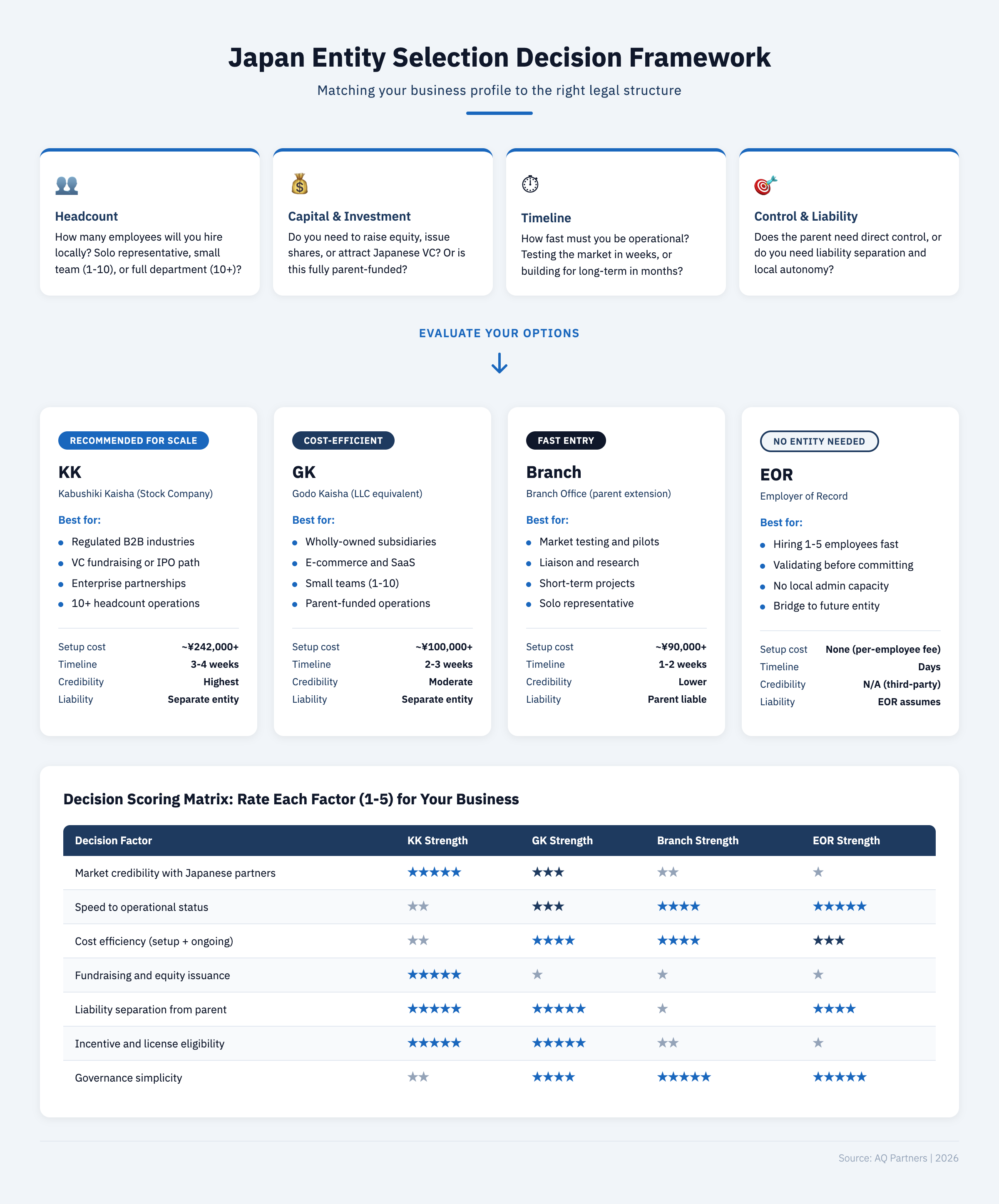
Scenario mapping: pilot sales, ecommerce, R&D, regulated B2B
Scenario mapping is an effective tool for tailoring your entity selection to your specific go-to-market and sector context, turning abstract frameworks into actionable plans.
For example, a foreign company planning initial pilot sales or market testing may opt for a branch office or GK for quick entry and minimal regulatory burden. In regulated B2B sectors such as finance or healthcare, a KK is almost always required due to licensing, investor expectations, and industry credibility. For joint R&D and innovation, LLPs are most advantageous, offering tax transparency and flexible management for collaborative projects. Where investment pooling is needed—especially for real estate or project finance—the TK structure enables limited-liability silent partnerships. According to PwC's Japan tax summary, the combined effective corporate tax rate of approximately 30-34% applies regardless of entity type, meaning structural decisions should prioritize operational fit over marginal tax differences.
This approach not only safeguards compliance but also offers flexibility as your business evolves. By mapping entity choices to scenarios like ecommerce, hiring, regulatory scale-up, or investment needs, you can build an adaptable structure aligned with Japan's changing business environment. Teams planning to hire locally should also weigh the differences outlined in our EOR vs entity Japan hiring guide.
Conversion paths: GK to KK and Branch to Subsidiary triggers
Flexibility to convert entity types is a valuable strategic advantage, letting companies adapt their structure as they grow or as compliance and investment needs shift. Many international businesses start as GKs or branches, then transition to KKs or wholly owned subsidiaries as their market, regulatory, or capital requirements expand.
A common path is to begin with a GK for agility and cost savings, then convert to a KK once significant investment, board governance, or senior Japanese hires are needed. Similarly, a branch might be upgraded to a local subsidiary to meet regulatory demands, enhance liability protection, or gain access to regional incentives and licenses. JETRO notes that such conversions are common as entities scale and regulatory complexity increases. Triggers include investor demand for transparent shareholding, compliance with industry rules, or strategic needs such as hiring or IP protection. Planning for these transitions from the start ensures operational continuity and better positions your business for long-term success in Japan. Companies preparing for this transition should also understand the Japan inkan (corporate seal) system, as registered seals must be updated when the entity type changes.
Tax, governance, and investor considerations
Japanese corporate tax rates of approximately 30-34% apply equally across KKs, GKs, and branches, but withholding tax, transfer pricing, thin capitalization, and audit obligations vary significantly by entity structure and size. Selecting the appropriate entity structure in Japan requires informed navigation of tax regulations, corporate governance practices, and investor expectations. These factors are critical for operational effectiveness, legal compliance, and ensuring alignment with both global stakeholders and local partners. The following sections clarify core areas: tax logistics, risk management, governance, and investor relations for overseas-backed Japanese entities.
Repatriation routes, WHT, and branch profit mechanics
Foreign companies and their Japanese subsidiaries must have clear strategies for repatriating profits to their parent organizations. For KKs and GKs, dividends to overseas shareholders are generally subject to withholding tax (WHT), typically between 15% and 20%, depending on applicable tax treaties between Japan and the investor's home country, according to the National Tax Agency. Effective treaty structuring can reduce WHT, whereas noncompliance leads to taxation at Japan's full statutory rate. For a deeper look at how corporate tax obligations apply, see our guide on corporate income tax rates and filing in Japan.
For branches, which are considered extensions of the parent company, after-tax profits can typically be remitted abroad without incurring Japanese WHT, though those profits are still taxed as locally sourced income. Careful tax planning is required to avoid double taxation across jurisdictions. Companies should consult bilateral treaties and collaborate with tax advisors to optimize profit remittance, ensuring compliance and preserving value. For comprehensive filing guidance, see our Japan corporate tax compliance guide.
PE risk, transfer pricing, thin cap, and interest limits
Permanent Establishment (PE) risk is critical for foreign businesses, as a local office qualifying as a PE gives Japan taxing rights on the associated income. Triggers for PE include having a fixed office, ongoing operational presence, or an empowered local agent. PE status brings full Japanese corporate tax obligations.
Additionally, transfer pricing rules require that all transactions with related overseas parties adhere to arm's length principles. Comprehensive documentation is required, and noncompliance can result in penalties or retrospective tax increases. Businesses using debt financing must consider thin capitalization rules, especially in a parent-subsidiary context. Typically, a 3:1 debt-to-equity ratio is the maximum for interest deductibility; exceeding this limit can render excess interest nondeductible. These regulations are strictly enforced to prevent profit shifting, making early consultation with tax and legal advisers essential to avoid PE risks and hidden liabilities.
Audit thresholds, disclosure duties, and recurring costs
Ongoing compliance varies significantly with entity size and type. Large KKs—with paid-in capital over ¥500 million or liabilities above ¥20 billion—are required to undergo statutory audits by certified public accountants under the Companies Act. Mid-sized KKs also face higher disclosure standards, including routine financial reporting and formal meeting minutes. Understanding the differences between Japanese and international accounting standards is also important when preparing these disclosures.
All major entities in Japan must file annual corporate tax returns, maintain accurate local bookkeeping, and meet recurring government filing obligations. KKs typically bear the highest costs for governance and auditing, due to their greater transparency and reporting requirements. While GKs and branches enjoy leaner compliance obligations, regulatory demands increase as the business grows. It is essential for company leadership to plan ahead for audit, legal, and internal control investments. For key deadlines and schedules, review the post-incorporation filing requirements in Japan.
Conclusion
Choosing the right legal entity when entering Japan requires a nuanced, strategic approach that balances speed, credibility, control, and cost while considering Japanese regulations and global business priorities. Whether you are evaluating a KK, GK, branch, LLP, or joint venture, each offers specific benefits, limitations, and triggers linked to market, compliance, and investor needs. Ongoing management of regulatory, tax, and governance obligations is crucial not just at launch, but throughout your company's growth, to protect your brand, secure investment, and foster long-term success. By leveraging structured decision frameworks and local incentives, international founders and growth teams can build a strong operational foundation in Japan—enabling them to focus on expansion and value creation, instead of administrative complexity. Strategic and informed entity structuring is more than a compliance necessity—it is a cornerstone for lasting business achievement in Japan.
Working with AQ Partners. Our Tokyo team provides KK and GK incorporation for foreign companies operating in Japan. Book a consultation to discuss your situation.

Yuga Koda is a founding Director at AQ Partners, supporting foreign companies, funds, and families operating in Japan. His experience operating companies in both Japan and international markets gives him a practical understanding of back office operations from both sides.