
Untangling Japan’s Inkan System


Untangling Japan's inkan (seal) system is often one of the most perplexing—and essential—challenges for international startups, founders, and global teams entering the Japanese market. An inkan is a carved stamp used in place of a handwritten signature to authenticate documents, authorize transactions, and establish legal intent under Japanese law. Seals are embedded throughout legal and business processes, appearing on nearly every document that requires formal recognition, from contract execution to banking. As Japan accelerates its digital transformation and updates its legal framework, understanding the relationship between inkan, e-signatures, and cross-border compliance is critical to establishing a compliant and efficient business foundation.
Key Takeaways
- Japan requires registered corporate seals for incorporation and major filings. The jitsuin (registered seal) must be filed with the Legal Affairs Bureau before a company can execute contracts, open bank accounts, or submit regulatory documents—making seal procurement a Day 1 priority for market entry.
- Four distinct seal types serve different corporate functions. Companies operating in Japan typically maintain a jitsuin (registered seal), ginkō-in (bank seal), kakuin (company seal), and mitome-in (daily-use seal), each with specific legal standing and use cases that cannot be interchanged.
- Physical seals remain mandatory for certain high-value transactions. Despite ongoing digitization, real estate filings, notarized corporate documents, and bank account openings still require physical inkan as of 2026—no digital alternative is permitted for these processes.
- E-signatures now carry legal parity for most business contracts. Under the Act on Electronic Signatures and Certification Business, compliant e-signature platforms are accepted for employment agreements, NDAs, procurement, and ongoing tax filings, provided authentication and traceability standards are met.
- Seal governance and custody controls are essential for compliance. Dual-control access, imprint logging, and role-based custody protocols protect against unauthorized use and are considered fundamental corporate governance requirements by Japanese regulators and financial institutions.
Inkan essentials and Japanese documentation mapping
The inkan's function extends far beyond that of a simple stamp: it serves as the core symbol of authenticity and legality for agreements, regulatory filings, and even daily business transactions. For overseas companies and startups, understanding how these seals are used across Japanese corporate documentation isn't just a bureaucratic detail—it's essential to compliance and operational readiness.
Inkan types and corporate roles
For newcomers to the Japanese market, grasping the basic types of inkan is crucial for compliance and smooth operations. The core features and business implications of each seal type include:
- The jitsuin (registered seal) holds the highest legal authority and is required for official company actions such as incorporation and regulatory filings. It must be registered with the local Legal Affairs Bureau as part of the company formation process. Under Article 228(4) of the Code of Civil Procedure, a document bearing a registered seal enjoys a legal presumption of authenticity.
- The mitome-in (unregistered daily-use seal) is typically used for internal documents and approvals that do not carry legal risk, making it less critical from a compliance standpoint.
- The ginkō-in (bank seal) is exclusively used for banking transactions and must be registered with each financial institution involved.
- The kakuin (company seal / square seal) is the general-purpose corporate stamp bearing the company name, commonly used on invoices, quotations, and business correspondence.
- Most Japanese companies maintain all four seal types, with access strictly limited to designated officers or legal representatives.
- Using the wrong seal can invalidate documents and disrupt legal or business processes, exposing companies to unnecessary risks.
- Assigning appropriate roles and enforcing strong controls over seal use is a fundamental governance requirement for any international team operating in Japan.
| Seal Type | Japanese Name | Primary Purpose | Registration Required | Typical Use Cases |
|---|---|---|---|---|
| Registered Seal | Jitsuin (実印) | Highest legal authority for official acts | Yes — registered at the Legal Affairs Bureau | Incorporation, real estate, regulatory filings, notarized contracts |
| Bank Seal | Ginkō-in (銀行印) | Banking and financial transactions | Yes — registered at each financial institution | Opening accounts, wire transfers, banking authorizations |
| Company Seal | Kaisha-in / Kakuin (会社印 / 角印) | General corporate stamp for business documents | No formal registration required | Invoices, estimates, quotations, general correspondence |
| Daily-Use Seal | Mitome-in (認印) | Routine internal use, low-risk approvals | No registration required | Internal memos, delivery receipts, minor approvals |
| Representative Director Seal | Daihyō-in (代表印) | Acts on behalf of the representative director personally | Yes — registered at the Legal Affairs Bureau | Signing authority delegation, director-level contracts, shareholder agreements |
| Division Seal | Bumon-in (部門印) | Department-level authorization | No registration required | Departmental purchase orders, internal transfers, section-level approvals |
| Rubber Stamp | Gom-in / Shachihata (ゴム印 / シャチハタ) | Non-binding identification stamp | Not accepted for legal or banking use | Address stamps, date stamps, parcel receipts, visitor logs |
| Personal Registered Seal | Kojin Jitsuin (個人実印) | Personal legal authentication for individuals | Yes — registered at municipal office | Personal guarantees, property purchases, loan agreements, individual contracts |
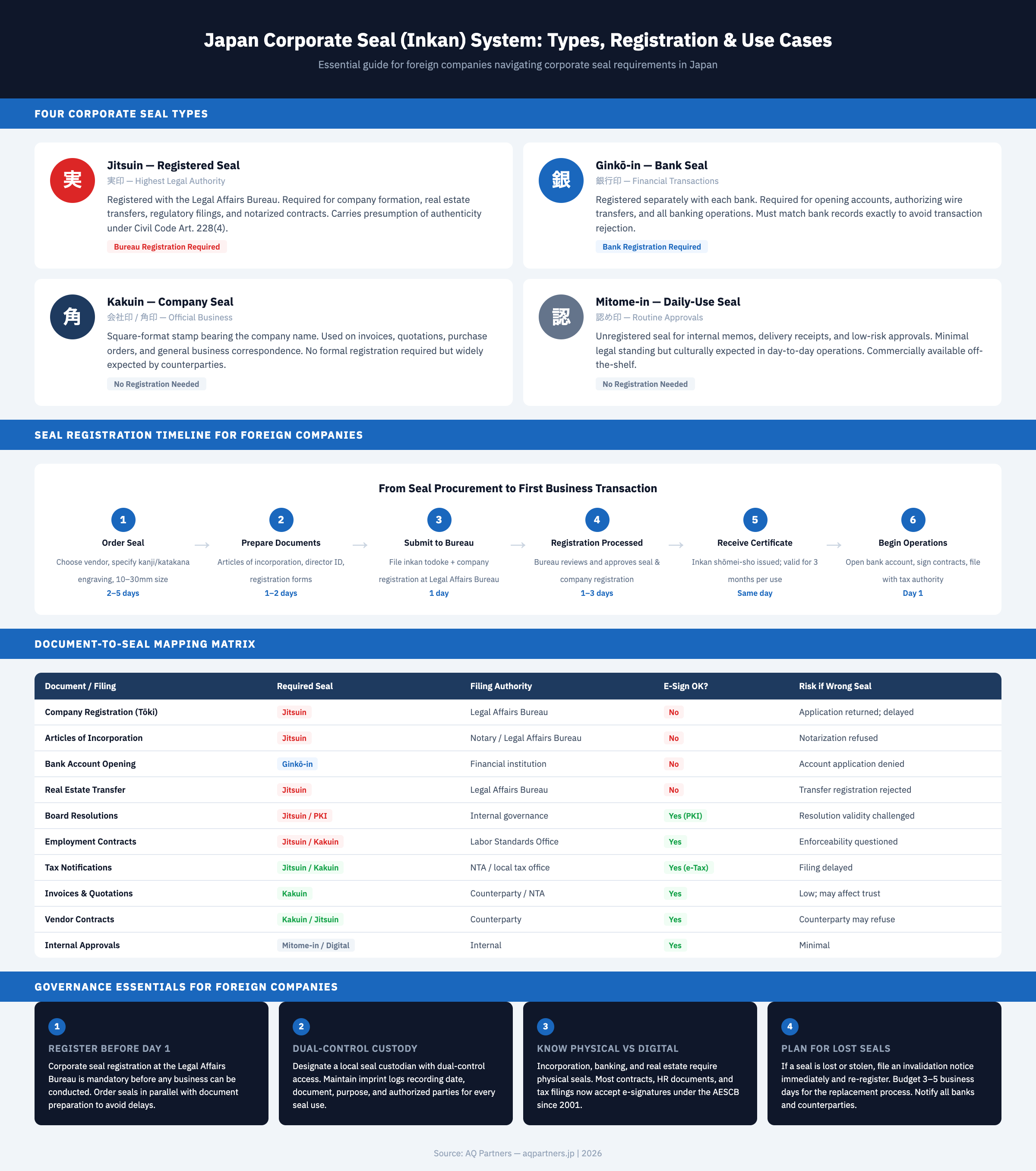
Document-to-seal mapping matrix
Mapping the correct inkan to each procedural document is another critical step. In Japan, regulatory filings, company registrations, contract executions, and banking operations all have specific seal requirements. For instance, company registration forms always require the registered jitsuin, a requirement detailed by JETRO and the Tokyo One-Stop Business Establishment Center. Using the wrong seal can lead to immediate rejection or significant processing delays. Internal procedures may also dictate different inkan types based on document sensitivity or audit requirements.
| Document / Filing | Required Seal Type | E-Signature Permitted | Filing Authority | Rejection Risk if Wrong Seal |
|---|---|---|---|---|
| Company Registration (Tōki) | Jitsuin (registered seal) | No | Legal Affairs Bureau | Application returned; incorporation delayed |
| Articles of Incorporation | Jitsuin (registered seal) | No | Notary Public / Legal Affairs Bureau | Notarization refused |
| Bank Account Opening | Ginkō-in (bank seal) | No | Financial institution | Account application denied |
| Real Estate Purchase/Transfer | Jitsuin (registered seal) | No | Legal Affairs Bureau | Transfer registration rejected |
| Tax Authority Notifications | Jitsuin or kakuin | Yes (e-Tax system) | National Tax Agency / local tax office | Filing delayed; follow-up required |
| Employment Contracts | Jitsuin or kakuin | Yes (compliant platform) | Internal / Labor Standards Office | Contract enforceability questioned |
| Vendor / Service Contracts | Kakuin or jitsuin | Yes (compliant platform) | Counterparty | Counterparty may refuse document |
| Board Resolutions | Jitsuin (representative director) | Yes (qualified e-sig with PKI) | Internal governance | Resolution validity challenged |
| Invoices and Quotations | Kakuin (company seal) | Yes (e-stamp with timestamp) | Counterparty / NTA | Low; may affect partner trust |
| Internal Memos and Approvals | Mitome-in or digital | Yes | Internal | Minimal |
Global founders and lean teams should plan for these requirements to avoid unnecessary administrative setbacks. Creating a matrix that maps business processes to the appropriate seal type is a best practice, ensuring the right seal is ready at every critical step—from partnership agreements and bank account openings to post-incorporation filing requirements.
Stamp placement and red ink norms
In Japan, not only the type but also the presentation of the seal is important. The tradition is to use red ink (shuniku) for all official inkan impressions, a standard rigorously upheld by both authorities and financial institutions. Official documents designate specific areas for the inkan, which must be placed precisely, centered, and clear—free from smudging or double impressions. According to the World Bank's business guides, improper placement or unclear impressions are among the leading reasons for document rejection by banks or government offices, resulting in costly delays and rework.
For remote and cross-border teams, these detailed presentation standards may seem minor, but they are crucial for success in Japan's paper-based regulatory environment. Establishing clear internal protocols for inkan handling—including ink color and placement—prevents avoidable errors and the risk of statutory filings, contracts, or banking authorizations being rejected.
A thorough understanding of inkan practices and their alignment with Japan's digital transformation is increasingly essential, ensuring compliance with legal and technological standards as they evolve.
2020–2026 digitization and e-signature rules in Japan
Japan's approach to digitizing seals and signature processes has advanced rapidly since 2020, driven by remote work needs and a national digital government initiative led by the Digital Agency. Building compliance in this blended environment—where physical seals and e-signatures coexist—demands careful attention to reform timelines, persistent exceptions, and the evidentiary standards for legal acceptance.
Reform timeline and current thresholds
The move toward a more digital-friendly business environment has featured key milestones and ongoing exceptions:
1. In 2020, digital processes gained substantial government and market support, largely to accommodate new remote work and paperless initiatives prompted by COVID-19 disruptions.
2. By 2021, most administrative, tax, and HR paperwork could be completed and submitted online through systems like e-Gov and e-Tax, offering significant efficiency gains.
3. Nonetheless, real estate filings, certain corporate approvals, and documents needing notarization still require physical inkan.
4. Regulatory sources such as METI advise keeping up-to-date, as the list of exceptions changes with each reform cycle.
5. To avoid compliance errors, distributed and international teams should schedule regular legal reviews as laws and practices continue evolving through 2026 and beyond.
Transactions requiring physical seals
Despite increasing digitization, critical processes in Japan still mandate physical seals. Real estate transactions, property and registry applications, and important corporate authorizations require a registered inkan. Regulatory filings—especially those done in person or requiring notarization—also hinge on original stamp impressions, as emphasized by JETRO and the Ministry of Justice.
Startups and foreign founders cannot overlook the importance of physically handling, applying, and safeguarding the company inkan. Omitting these steps can lead to invalid filings and legal complications. Even primarily remote teams should develop hybrid protocols to accommodate both digital signatures and traditional inkan, depending on the process.
Where e-signatures are accepted
E-signatures, when compliant with Japan's Act on Electronic Signatures and Certification Business, are now accepted across a wide range of business activities. Since 2021, reputable e-signature platforms have been recognized for most business contracts, e-commerce agreements, HR documents and compliance filings, and ongoing tax filings. Guidance from the Digital Agency and METI confirms that digital signatures are legally valid if they ensure authentication, non-repudiation, and traceability in accordance with Japanese law.
This digital transition is a significant advantage for global teams, enabling routine operations to move online with greater efficiency, faster collaboration, and comprehensive audit trails. However, teams must verify the acceptability of e-signatures in each context—especially when working with government agencies, traditional industries, or regulated sectors—to avoid invalid agreements or rejected filings.
Evidence and audit artifacts
Japanese law requires not just the use of e-signatures but also strict evidence management. Organizations must maintain digital audit trails, certificates, and reliable timestamps for every signed document or submission. These records are essential for dispute resolution, regulatory compliance, and audits, as outlined by the Cabinet Office Digital Archives and the Digital Agency's e-Document Act guidance.
For global teams, adopting e-signatures is only the first step. They must use solutions that automatically generate and protect this evidence, ensuring that records are accessible and verifiable over time. Failing to maintain these digital audit artifacts can render contracts unenforceable and result in regulatory penalties, underscoring the need for robust document management in Japan's evolving legal environment.
In this hybrid seal environment, cross-border founders must also navigate practical challenges, such as signature validation for non-resident workflows or when lacking a local entity.
Corporate seal governance, procurement, and security
Preserving the integrity and legal validity of a company's seals is paramount in Japan, where misuse or compromise of a registered inkan can result in significant legal and operational issues. Understanding security protocols, procurement procedures, and governance best practices is essential for global teams committed to compliance and operational resilience in the Japanese market.
Seal custody and role-based access
To ensure strong governance and minimize risk, Japanese companies implement strict protocols for seal access and custody:
- Company seals are kept secure, typically in a locked cabinet or safe, with access limited to specific officers or legal representatives.
- A role-based model determines who may access or use the seal, significantly reducing the risk of misuse or fraud.
- Organizations maintain detailed access logs, documenting who accessed the seal, for what business purpose, and under what circumstances.
- These records become key audit artifacts during compliance investigations or disputes.
- International teams should formalize these protocols in internal policies, ensuring all access is traceable and justified.
Dual-control and imprint logs
Many Japanese firms use dual-control systems that require two authorized officers to be present when using the seal, particularly for high-value transactions like banking or regulatory filings. These controls are often supplemented by imprint logs, which record details such as the date, document, responsible parties, and the purpose of each seal use, as noted by the Tokyo Chamber of Commerce.
This level of traceability is not just a best practice but a core aspect of corporate governance, preventing internal fraud and reinforcing trust with regulators and partners. Even basic digital or spreadsheet-based logging can offer significant risk reduction and enhance credibility for global teams without adding much overhead, according to the Tokyo Chamber of Commerce.
Materials, scripts, and legibility
A company seal's validity and acceptance depend not only on security protocols but also on its physical properties. Inkan are typically crafted from wood, horn, titanium, or synthetic materials, with the choice reflecting the company's commitment to tradition and security. Titanium seals have become increasingly popular for corporate use due to their exceptional durability and resistance to wear. Engraving—usually in kanji and sometimes in Roman letters for foreign-owned firms—must be clear and easy to read. The Legal Affairs Bureau specifies size requirements for registered corporate seals: they must fit within a square between 10mm and 30mm per side. Any ambiguity or damage can result in a seal's rejection during official filings or banking transactions, as highlighted by the Japanese National Printing Bureau.
When procuring an inkan, founders and operations leaders should prioritize precision engraving, high legibility, and durability. These features have a direct impact on compliance and business reputation. Replacing a damaged or substandard seal often requires additional legal filings and can delay critical business operations, as stated by the Japanese National Printing Bureau.
Security features and vendor vetting
Modern corporate and banking seals increasingly use anti-tampering engravings, registration certificates, and other authentication features to prevent forgery. It is vital to source seals from vendors approved by local registrars or recommended by legal advisors. The Ministry of Economy advises that registration sealing certificates and security-engraved inkan reduce the risk of forgery.
Always obtain a registration or security certificate from the seal vendor, as this simplifies verification and greatly lowers the risk of counterfeiting—an increasing concern in the era of cross-border transactions and digital documentation. Choosing reputable, well-established seal makers rather than unvetted online sellers is a modest expense that can prevent significant future problems, according to the Ministry of Economy.
Effective management of these governance procedures ensures legal defensibility and operational agility, giving foreign-led companies an advantage in building trust with Japanese partners and authorities.
Operational workflows: banking, contracting, incorporation
Effectively managing bank account openings, contract execution, and incorporation in Japan requires detailed knowledge of how seals and e-signatures fit within the compliance framework. Each process presents unique requirements, and mistakes can cause substantial delays or rejection of crucial filings.
Bank seal creation and registration
Here are the key steps and considerations for creating and registering a corporate bank seal in Japan:
1. Decide on a distinctive seal design, ensuring it is different from general corporate and personal seals for security and identification purposes.
2. Have the ginkō-in manufactured, confirming it meets your chosen bank's standards for size, material, and engraving clarity.
3. Register the seal in person at your bank, presenting all required company documents and identification as specified by the bank.
4. Limit access and use of the seal to officers whose names appear in official company records, as required by the Japanese Bankers Association.
5. After registration, ensure all future banking transactions and account management actions are carried out using the registered ginkō-in.
6. If a bank seal is lost or compromised, immediately notify the bank to freeze the seal registration and begin the re-registration process with new documentation and a replacement seal.
Bank document checklist and variations
Opening a corporate bank account in Japan requires a specific set of documents, each with its own requirements. Commonly required items include a company registry certificate (tōhon), the seal registration certificate (inkan tōroku shōmei-sho), articles of incorporation, and the physical inkan for branch presentation. Depending on the bank, you may also need to provide proof of address, identification for all directors, or business plans, particularly for new startups or foreign-owned firms. Requirements can vary between banks and by legal entity type such as KK, GK, or branch office. Major banks such as MUFG may have stricter requirements than local institutions. Incomplete applications or incorrect seals are leading causes of delays, so careful pre-submission checklists and document verification are crucial for first-time applicants, according to MUFG Bank. Reviewing specialized banking articles relevant to Japan can keep global teams updated on best banking practices.
Contracting decision framework: seal or e-signature
While e-signatures are now widely accepted for many contracts and internal procedures, their adoption remains inconsistent. Large corporations and global tech firms often prefer e-signatures for their speed and auditability, yet many partners—especially in government, real estate, and traditional sectors—still demand physical inkan for contracts to be valid.
A best-practice approach involves assessing partner preferences and regulatory requirements for each case. If an inkan is required, a digital solution is only practical with explicit written acceptance. Wherever possible, leverage e-signatures for efficiency—provided your platform meets Japanese authentication and data retention standards, as outlined by METI.
Incorporation timeline and seal-dependent filings
Establishing a legal entity in Japan is closely tied to inkan-based workflows, particularly in the early post-formation stages. Choosing the right entity structuring strategy for Japan entry is a critical first step. Producing and registering company seals with authorities adds an extra 1–3 business days to standard documentation timelines. Core filings—including company registry applications, tax authority notifications, and bank account openings—still require stamped documents, even as digital reforms continue, per JETRO guidelines.
Any delay in seal production, registration, or proper usage can jeopardize critical launch activities. Proactively synchronizing seal procurement with other incorporation steps, such as document translation and director onboarding, can significantly streamline the process, according to JETRO. Teams should also familiarize themselves with chart of accounts management in Japan early on, as financial setup depends on having registered seals in place.
Successfully setting up operations in Japan requires more than basic checklists. Embedding seal awareness into team training, process documentation, and ongoing compliance culture is essential.
Seal registration process: step-by-step for foreign companies
For foreign companies establishing a presence in Japan, the seal registration process involves specific procedural steps that differ slightly from domestic company formation. Understanding this process in advance prevents delays during the critical incorporation phase.
Pre-registration preparation
Before registering a corporate seal, the company must first complete several preparatory steps. The representative director or branch manager must be formally appointed, and the company's articles of incorporation must be drafted and notarized (for KK entities). The seal itself must be manufactured to Legal Affairs Bureau specifications—round in shape for registered seals, with the company name and representative title clearly engraved in kanji. Foreign company names are typically transliterated into katakana for the seal face, though Roman letters may be permitted depending on the jurisdiction. The seal must be between 10mm and 30mm per side to be accepted for registration.
Registration at the Legal Affairs Bureau
The actual registration takes place at the Legal Affairs Bureau (Hōmukyoku) that has jurisdiction over the company's registered address. The representative director or an authorized proxy submits the seal registration application (inkan todoke) along with the company registration application. Required documents typically include the seal itself for impression, identification documents for the representative, and the company's articles of incorporation. Upon acceptance, the bureau issues a seal registration certificate (inkan shōmei-sho), which serves as official proof that the seal is registered and can be used to verify seal impressions on future documents. This certificate is frequently requested by banks, notaries, and counterparties for high-value transactions.
Obtaining seal certificates
After registration, companies can request seal certificates (inkan shōmei-sho) from the Legal Affairs Bureau as needed. These certificates are typically valid for three months from the date of issuance and must be refreshed for each major transaction. The National Tax Agency and financial institutions routinely require current seal certificates as part of their verification procedures. Companies should budget for the ongoing administrative cost and time required to obtain fresh certificates before deadlines for major filings or banking transactions.
Frequently Asked Questions
Can a foreign company use a Roman-letter seal instead of kanji?
The Legal Affairs Bureau generally requires that corporate registered seals (jitsuin) include the company name in Japanese characters—typically katakana for transliterated foreign names. Some jurisdictions permit Roman letters on certain seal types, but this varies by local bureau. For the registered seal used in company formation, katakana or kanji engraving is the standard and safest approach. Non-registered seals such as the kakuin (company seal) may use Roman letters for internal or correspondence purposes without legal restriction.
What happens if a registered corporate seal is lost or stolen?
If a registered seal is lost or stolen, the company must immediately file a seal invalidation notice (inkan haikō todoke) with the Legal Affairs Bureau to prevent unauthorized use. The company then procures a new seal and re-registers it through the standard registration process. Until the new seal is registered, the company cannot execute documents requiring a registered seal impression. Banks and other institutions holding the old seal impression on file must also be notified and updated. This process typically takes 3–5 business days and should be treated as an urgent governance matter.
Are digital seals or cloud-based seal services legally valid in Japan?
Cloud-based seal services and digital seal impressions are gaining adoption for internal workflows and lower-risk documents. However, as of 2026, digital seals are not accepted as substitutes for physical registered seals (jitsuin) in company formation, real estate transactions, or bank account openings. For contracts and business documents where e-signatures are permitted under the Act on Electronic Signatures and Certification Business, compliant digital platforms can replace traditional seal use—provided they meet Japanese authentication, non-repudiation, and timestamping requirements.
How many seals does a typical foreign-owned company need in Japan?
Most foreign-owned companies operating in Japan maintain at least three seals: a jitsuin (registered seal) for legal and regulatory filings, a ginkō-in (bank seal) for financial transactions, and a kakuin (company seal) for invoices and general correspondence. Larger operations may also maintain departmental seals (bumon-in) and daily-use seals (mitome-in) for internal approvals. Each seal should be distinct in design to prevent confusion and unauthorized cross-use. Budgeting for procurement, secure storage, and access controls for all seals is an important part of initial market entry planning.
How long does seal registration take during company incorporation?
Seal registration is submitted simultaneously with the company registration application at the Legal Affairs Bureau. The registration itself is typically processed within 1–3 business days after submission. However, companies should allow additional time for seal manufacturing (2–5 business days depending on the vendor and material), document preparation, and scheduling an appointment at the bureau. The total timeline from ordering a seal to receiving the seal registration certificate is usually 5–10 business days. Planning seal procurement in parallel with other incorporation steps—such as notarization of articles and capital deposit—helps avoid bottlenecks.
Conclusion
Japan's inkan system remains a cornerstone of corporate legitimacy and trust, even as rapid digitization reshapes the business environment. To succeed, global teams must master both traditional seal practices and current e-signature laws, paying close attention to translation, security, and regulatory details. Whether founding a startup or expanding international operations, implementing best practices for seal governance, vendor selection, and workflow design will ensure smoother market entry and minimize legal and operational risks. By combining proficiency in legacy protocols with fluency in digital processes, ambitious teams can spend less time on administrative hurdles and more time building their business in Japan.
Working with AQ Partners. Our Tokyo team provides entity seal storage and administration and KK and GK incorporation for foreign companies operating in Japan. Book a consultation to discuss your situation.

Yuga Koda is a founding Director at AQ Partners, supporting foreign companies, funds, and families operating in Japan. His experience operating companies in both Japan and international markets gives him a practical understanding of back office operations from both sides.