
Setting Up Payroll in Japan: Step-by-Step

Key Takeaways
- Four registrations must be completed before paying any employees — labour standards office, employment insurance, pension, and health insurance. Most deadlines fall within 5–10 days of hiring, making the sequence time-sensitive from day one.
- The 36-agreement is a prerequisite for legal overtime — Filing the 時間外労働協定届 (sanroku kyotei) with the Labour Standards Office must happen before any overtime is worked, not after an employee requests it.
- Late social insurance enrollment carries retroactive penalties — Coverage is assessed from the employee's first day of employment, and penalties apply from that date regardless of when the enrollment is actually filed.
- Your payroll bank account must support FBデータ transfer format — Not all business accounts do. Confirming this before your first pay date avoids a hard stop in the disbursement process.
- Payroll software configuration takes time — start before your first hire — Entering company registration numbers, employee My Numbers, social insurance rates, and tax withholding tables cannot be done on the day of the first pay run.
Setting up payroll for a new Japan entity involves a specific sequence of government registrations, each with its own filing window and enforcement body. Unlike many countries where payroll is largely a software and bank configuration exercise, Japan requires employers to complete four separate registration tracks — labor law, employment insurance, pension, and health insurance — before any employee can be legally paid. This guide walks through each step in the order it must be completed, the exact deadlines involved, and the most common mistakes that cause delays or penalties. For guidance on payroll software selection, see our payroll software Japan guide. For a complete overview of Japan payroll obligations, see our Japan payroll guide.
Before Your First Hire: What You Need in Place
Four registrations must be completed before paying any employees: labour standards office, employment insurance, pension office, and health insurance. These are sequential and time-sensitive — most must be done within 5–10 days of hiring.
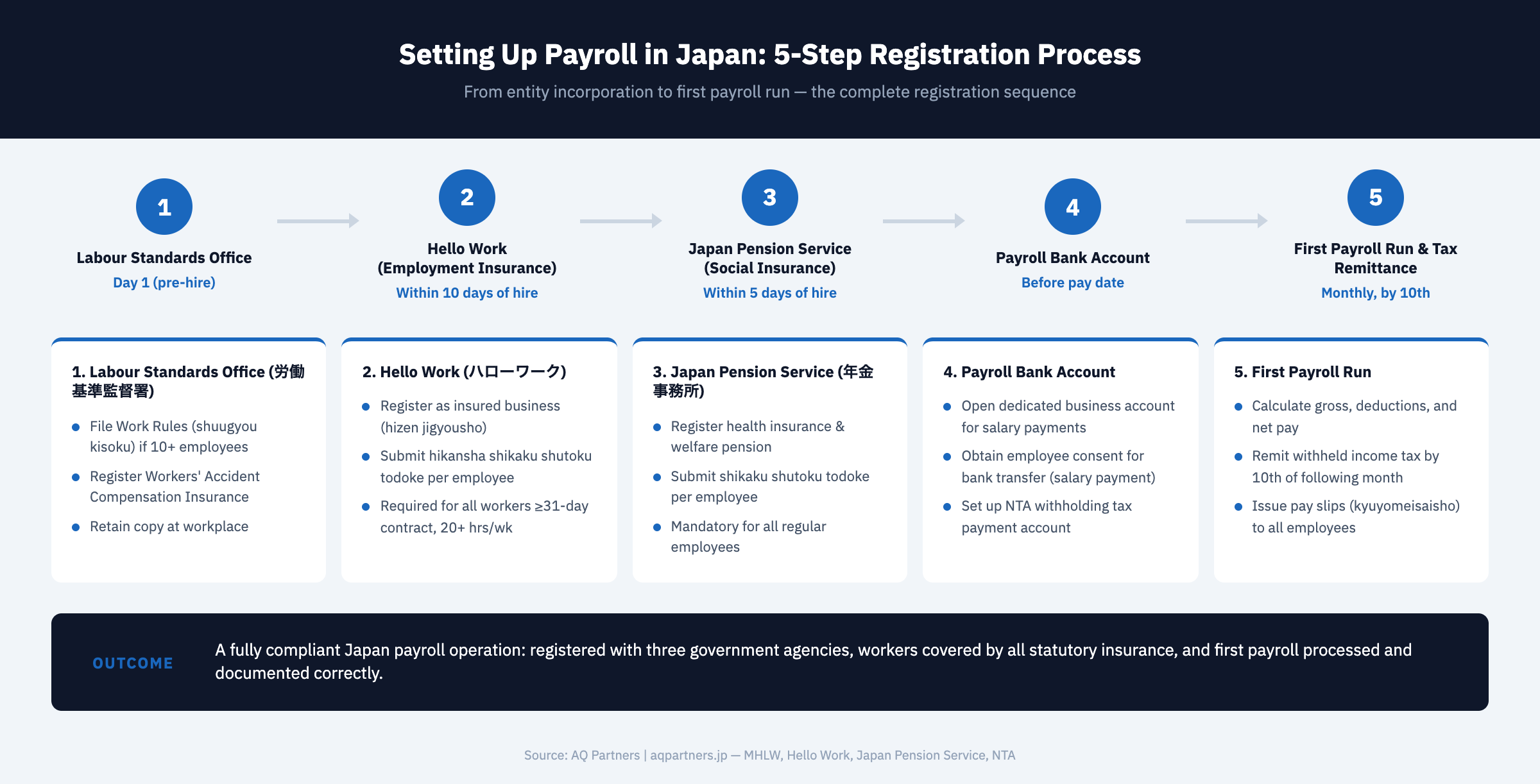
Payroll setup for a new Japan entity is not a single administrative event — it is a series of registrations across four government bodies, each with its own deadlines, forms, and filing requirements. The sequence matters: some registrations must precede others, and several deadlines run from the date of first hire rather than from entity establishment. Missing a deadline does not simply mean filing late — it often means penalties calculated back to the date of first employment.
In addition to the four registration tracks, two operational items must be in place before the first payroll run: a payroll bank account with FBデータ (FB data) bulk transfer capability, and payroll software configured with the correct company registration numbers, employee data, and insurance rates. Neither of these can be left until the pay date itself. The Ministry of Health, Labour and Welfare (MHLW) oversees the labour standards and employment insurance registrations; the Japan Pension Service handles social insurance.
The four steps below cover the registrations in the order they are typically completed. Step 4 and Step 5 — bank account and software configuration — can run in parallel with the government registrations and should be started as early as possible.
Step 1 — Register with the Labour Standards Office (労働基準監督署)
File the notification of establishment (事業場設置届) with the Labour Standards Office in your business address jurisdiction within 10 days of starting operations. If any overtime will be worked, also file the 36-agreement (時間外労働協定届) before the first overtime hour is logged.
The first registration is with the Labour Standards Office (労働基準監督署, rodo kijun kantokusho) — the MHLW body responsible for enforcing the Labour Standards Act. The primary filing is the notification of establishment (事業場設置届), which notifies the office that a new workplace has opened in its jurisdiction. This must be submitted within 10 days of beginning operations at the business address.
The filing is straightforward but must be submitted to the correct office — the Labour Standards Office corresponding to the municipality where the business is physically located, not a central office. The submission typically requires the business registration certificate, details of the workplace, and information about the representative.
A second filing is required if the company intends to have employees work overtime: the 36-agreement (時間外労働協定届, sanroku kyotei). Japan's Labour Standards Act prohibits overtime and holiday work beyond statutory limits without a valid 36-agreement on file with the Labour Standards Office. Critically, this filing must be in place before any overtime is worked — it cannot be filed retroactively to cover overtime that has already occurred. For entities that expect any overtime from their first employees, this filing should be treated as part of the establishment process rather than deferred.
Once the Labour Standards Office registration is complete, the entity receives a labour insurance number that will be required for subsequent filings with Hello Work (employment insurance) and for payroll software configuration.
Step 2 — Register for Employment Insurance (雇用保険)
File the business establishment notification (雇用保険 適用事業所設置届) with Hello Work within 10 days of the first hire. Then enroll each eligible employee individually within 10 days of their hire date. Employment insurance covers employees working 20 or more hours per week with 31 or more days of expected employment.
Employment insurance (雇用保険) registration is handled through Hello Work (公共職業安定所) — Japan's public employment service offices operated under the MHLW. There are two distinct filings required at this stage.
First, the business establishment notification (雇用保険 適用事業所設置届) registers the entity as an employer subject to employment insurance. This must be submitted within 10 days of the first hire. The filing requires the labour insurance number obtained in Step 1, along with the business registration documentation and details of the workplace.
Second, each individual employee must be enrolled separately by filing the employee qualification acquisition notice (被保険者資格取得届) within 10 days of their hire date. This enrollment establishes the employee's individual employment insurance record and is required for them to access benefits such as unemployment insurance if their employment ends.
Not all employees are subject to employment insurance enrollment. The standard eligibility criteria are: working 20 or more hours per week, and expected to be employed for 31 or more days. Part-time employees who fall below either threshold are not subject to employment insurance. However, the criteria apply from the start of employment — if an employee later moves to shorter hours, the change must be filed. For a complete breakdown of salary components and how they interact with insurance calculations, see our post on Japan salary structure, allowances, and bonuses.
Step 3 — Register for Pension and Health Insurance (社会保険)
File the new workplace notification (健康保険・厚生年金保険 新規適用届) with the Japan Pension Service within 5 days of establishing the office. Enroll each employee and their dependents within 5 days of hire. Most SMEs use Kyokai Kenpo (協会けんぽ) for health insurance; some industries use a sector-specific health insurance union.
Social insurance registration — covering both employees' pension (厚生年金) and health insurance (健康保険) — is a separate process from employment insurance and has a tighter deadline. The new workplace notification (健康保険・厚生年金保険 新規適用届) must be filed with the Japan Pension Service (日本年金機構) within 5 days of establishing the office.
Once the entity is registered, each employee must be individually enrolled. This includes filing for the employee and for any dependents they wish to register under the company's health insurance. Employee and dependent enrollment must also be completed within 5 days of the hire date — a shorter window than employment insurance and one that is frequently missed by new entities managing multiple simultaneous registrations.
Japan's health insurance system has two primary tracks for most employers. The majority of small and medium-sized enterprises enroll through Kyokai Kenpo (協会けんぽ), the Japan Health Insurance Association — a national association that sets premium rates by prefecture. Some industries operate their own health insurance unions (健康保険組合), which may offer different premium rates and benefit levels. Entities in industries with a relevant union should confirm whether membership is expected before defaulting to Kyokai Kenpo.
Premium rates for both pension and health insurance vary by prefecture and are updated periodically. The rates applicable at the time of registration must be input correctly into payroll software — incorrect rates will result in both under-withholding from employees and incorrect employer contributions. The PwC Japan Tax Summaries provides a useful reference for current social insurance contribution rates alongside other employer tax obligations.
Step 4 — Set Up Your Payroll Bank Account
Open a dedicated payroll bank account with FBデータ bulk transfer capability before the first pay date. The same bank as your employees reduces transfer fees. Confirm the bank supports FBデータ file upload via online banking before opening the account.
Japan's payroll disbursement system relies on FBデータ (FB data) — a fixed-format bulk transfer file that encodes all individual salary payment instructions in a standardized structure accepted by Japanese domestic banks. Payroll software such as SmartHR or MoneyForward Cloud Payroll generates this file automatically at the end of each payroll run. The employer then uploads it through their online banking portal to initiate all salary payments simultaneously.
Not all Japanese business bank accounts support FBデータ upload. Standard current accounts at some banks require a separate contract or account type to enable this functionality. Confirming FBデータ support before opening the account — or before the first pay date if an account is already open — avoids the scenario where payroll is calculated and ready but cannot be disbursed through the banking system.
Opening the payroll bank account at the same bank used by the majority of employees reduces inter-bank transfer fees on each pay cycle, which can accumulate to a meaningful cost at scale. Some major banks also offer payroll service APIs that integrate directly with domestic payroll platforms, automating the file upload step. Confirming integration capability during the bank selection process is worthwhile for entities expecting to scale headcount. For a full review of payroll software options that support FBデータ and bank integration, see our payroll software Japan guide.
Step 5 — Configure Payroll Software and Run First Payroll
Before the first pay run, configure payroll software with: company registration numbers, each employee's My Number and salary components, social insurance rates for your prefecture and health insurance association, NTA tax withholding tables, and the bank transfer schedule.
Payroll software configuration is a multi-step process that cannot be completed on the day of the first pay run. The key items to configure before the first payroll cycle are as follows.
Company registration numbers must be entered: the labour insurance number obtained from the Labour Standards Office in Step 1, and the social insurance establishment number assigned by the Japan Pension Service in Step 3. These numbers appear on social insurance filings and year-end tax documents, and must be accurate from the first payroll run.
Each employee record requires: My Number (individual identification number), salary components broken down correctly by base salary and allowances, dependent information for tax and social insurance purposes, and bank account details for disbursement. My Number must be collected from each employee using the prescribed process and stored securely — it is a regulatory obligation, not optional. For detail on how salary components affect insurance and tax calculations, see our post on Japan salary structure, allowances, and bonuses.
Social insurance rates must be configured for the correct prefecture and health insurance association — Kyokai Kenpo rates differ by prefecture and are updated annually each March. The National Tax Agency (NTA) publishes updated income tax withholding tables annually, and the current year's table must be loaded into the software before the first pay run. Finally, the bank transfer schedule — the date on which the FBデータ file is submitted to the bank and the value date on which employees receive payment — must be configured in line with the bank's processing calendar and the company's payroll cycle. For a full guide to payroll software selection and configuration for Japan, see our payroll software Japan guide.
Payroll Setup Checklist
| Task | Deadline | Filed With |
|---|---|---|
| File establishment notice (事業場設置届) | Within 10 days of operations start | Labour Standards Office |
| File 36-agreement (時間外労働協定届) if overtime planned | Before any overtime worked | Labour Standards Office |
| Register for employment insurance (適用事業所設置届) | Within 10 days of first hire | Hello Work |
| Enroll employee in employment insurance (被保険者資格取得届) | Within 10 days of hire | Hello Work |
| Register for social insurance (新規適用届) | Within 5 days of office establishment | Japan Pension Service |
| Enroll employee and dependents in social insurance | Within 5 days of hire | Japan Pension Service |
| Obtain employee My Numbers | Before first payroll run | (Retain internally) |
| Open payroll bank account with FBデータ capability | Before first payment | Bank of your choice |
| Configure payroll software | Before first payroll run | (Internal) |
| Issue employment contract | Before work starts | (Employee copy) |
Common Setup Mistakes to Avoid
The three most common errors when setting up payroll for a new Japan entity: enrolling employees late, missing the 36-agreement before requesting overtime, and using a bank account without FBデータ capability.
Late employee enrollment in social insurance is the most consequential mistake. Social insurance coverage — both health insurance and pension — is assessed from the employee's first day of employment. If enrollment is filed late, the Japan Pension Service calculates retroactive premiums from the correct start date, and the employer is liable for both the employer and employee contributions that should have been withheld. Late enrollment penalties are applied from the employment start date regardless of when the mistake is discovered. For context on the broader compliance obligations associated with Japan's social insurance system, see our post on Japan HR compliance strategies for global teams.
The second common mistake is treating the 36-agreement as something to file after overtime becomes necessary. Japan's Labour Standards Act makes overtime without a valid 36-agreement on file a violation from the first overtime hour — there is no grace period. New entities that expect to work any overtime in their first weeks of operation should treat the 36-agreement as a day-one filing alongside the establishment notice, not a subsequent administrative task. The JETRO Business Setup Guide covers the employment law framework applicable to new entities from the date of establishment.
The third common error is opening a standard business bank account without confirming FBデータ support. Not all Japanese business bank accounts include bulk payroll transfer capability by default. Entities that discover this limitation on the day of the first pay run have no fast resolution — bank account upgrades or changes typically require several business days to process. Confirming FBデータ upload capability during the account application stage, rather than assuming it is included, eliminates this risk entirely.
How AQ Partners Can Help
AQ Partners provides payroll setup and ongoing payroll processing services for foreign companies establishing new entities in Japan. We handle the full registration sequence — Labour Standards Office, Hello Work, Japan Pension Service, and health insurance association — on your behalf, coordinating the filings in the correct order and within the required deadlines.
Our setup services include employment contract review, payroll software configuration, social insurance enrollment for employees and dependents, My Number collection process setup, and first payroll run management. For entities that want ongoing support beyond setup, we offer retained payroll processing, monthly social insurance filing, and year-end nenmatsu chosei execution.
Ready to establish payroll for your Japan entity? Contact AQ Partners →

Yuga Koda is a founding Director at AQ Partners, supporting foreign companies, funds, and families operating in Japan. His experience operating companies in both Japan and international markets gives him a practical understanding of back office operations from both sides.