
Japan Payroll: The Complete Operational Guide
Japan payroll is the complete cycle of operational tasks an employer must run each month and throughout the year to pay employees legally and on time in Japan. That cycle encompasses collecting attendance data, calculating gross pay across base salary and allowances, computing statutory deductions for social insurance and income tax, generating the bank transfer file in Japan's FB data format, issuing payslips, and remitting withheld amounts to the relevant government agencies by the 10th of the following month. Beyond the monthly rhythm, Japan payroll carries significant annual obligations — above all the year-end tax adjustment (nenmatsu chosei), in which the employer reconciles each employee's income tax for the full calendar year. Understanding this operational structure is the prerequisite for any foreign company running or setting up payroll in Japan. This guide walks through each component in the order employers encounter them.
Key Takeaways
- ✓Japan payroll is employer-administered end to end — unlike most countries, the employer handles annual income tax reconciliation (nenmatsu chosei) for all employees, not the individual taxpayer.
- ✓The monthly cycle has nine distinct operational steps — from attendance cut-off to payslip issuance and agency remittance, each step has a defined deadline and statutory requirement.
- ✓Japan salary packages have multiple taxable and exempt components — commuting allowance is tax-exempt up to ¥150,000/month; overtime, housing allowance, and bonuses have distinct payroll treatments under Japanese law.
- ✓Annual obligations run year-round — social insurance annual review in April–July, new residence tax deductions in June, nenmatsu chosei in October–December, and withholding payment slips in January create a continuous compliance calendar.
- ✓Foreign employees and new entities require additional setup — residency status affects tax treatment, totalization agreements apply in 23 countries, and new entities must register with four separate government offices before the first payroll run.
What Makes Japan Payroll Operationally Distinct
Japan payroll is operationally distinct from most other jurisdictions in five concrete ways that affect every employer's monthly and annual workflow, regardless of company size or industry.
First, the employer executes year-end income tax adjustment on behalf of all employees. In most OECD countries, the individual files their own annual tax return. In Japan, the employer collects deduction declarations from each employee, recalculates annual income tax, and either refunds any overpayment in December or collects any shortfall — all through the payroll system. This nenmatsu chosei process has no functional equivalent in most countries and is one of the most common sources of compliance errors for foreign companies new to Japan. For a detailed walkthrough of the nenmatsu chosei workflow, see our dedicated guide on Japan payroll compliance: social insurance and nenmatsu chosei.
Second, Japan operates two parallel statutory insurance systems — shakai hoken (social insurance: health insurance and employees' pension) and rodo hoken (labor insurance: employment insurance and workers' accident compensation) — each with separate enrollment, contribution calculation, and monthly remittance procedures. The Ministry of Health, Labour and Welfare (MHLW) administers both systems and sets the regulatory framework employers must follow.
Third, salary bank transfers in Japan use a country-specific file format — FB (Full Bank) data — that must be generated by the payroll system and submitted to the employer's bank. This format is specific to Japan's banking infrastructure and is not standard on global payroll platforms without Japan-specific configuration.
Fourth, the 25th of the month is the dominant payroll payment date in Japan, established by custom and widely expected by employees. Japanese law requires salary to be paid on a fixed, predetermined date, and most employment contracts specify the 25th. Changing the pay date requires a works rules (shugyokisoku) amendment and, in unionized workplaces, collective bargaining.
Fifth, payslip issuance is legally required. The Labor Standards Act mandates that employers provide each employee with a written payslip (給与明細 kyuyo meisai) at the time of payment, detailing gross pay, all deduction line items, and net pay. Digital payslip delivery is permitted and widely used in cloud payroll systems.
Japan Salary Structure at a Glance
Japan salary packages are composed of multiple distinct components — each with its own Japanese legal term, tax treatment, and payroll calculation rule. Getting these right from the first payroll run is essential, as misclassifying a component can create retroactive tax and social insurance exposure.
The table below summarizes the eight most common salary components. For a full breakdown including allowance design considerations, bonus structuring, and retirement allowance tax treatment, see our dedicated post on Japan salary structure: allowances and bonuses.
| Component | Japanese Term | Payroll Treatment |
|---|---|---|
| Base salary | 基本給 kihon kyuyo | Fixed monthly; basis for social insurance calculation |
| Commuting allowance | 通勤手当 tsūkin teate | Tax-exempt up to ¥150,000/month |
| Housing allowance | 住宅手当 jūtaku teate | Taxable; common in multinational company packages |
| Overtime pay | 残業代 zangyo dai | 25–60% premium above base hourly rate; legally mandated |
| Summer bonus | 夏季賞与 kaki sho-yo | Discretionary; typically paid June–July; social insurance applies |
| Winter bonus | 冬季賞与 tōki sho-yo | Discretionary; typically paid December; withholding tax applies |
| Family allowance | 家族手当 kazoku teate | Employer discretion; not legally required; taxable as salary |
| Retirement allowance | 退職金 taishoku-kin | Not legally required; special favourable tax treatment on payment |
The Monthly Payroll Cycle
Japan's monthly payroll cycle follows a defined sequence of nine operational steps. Each step has dependencies on the previous one, and the entire cycle must complete in time for bank transfer execution by the 25th.
Step 1 — Set the cut-off date. The employer establishes the attendance data collection cut-off, typically the 15th to 20th of the month. This date defines the period for which hours, overtime, and leave data will be captured for the current payroll run. The cut-off date must be specified in the company's work rules (shugyokisoku) and communicated to employees.
Step 2 — Collect attendance data from the kinmu kanri system. Time and attendance records — regular hours, overtime hours by category (standard, late-night, holiday), paid leave taken, and any absences — are pulled from the attendance management (kinmu kanri) system and reviewed for completeness. Manager approval of timesheets is typically required before payroll can proceed.
Step 3 — Calculate gross pay. Gross pay is computed for each employee: base salary plus fixed allowances (commuting, housing, family) plus variable pay calculated from the attendance data (overtime pay, late-night premiums, holiday work premiums). Overtime calculations must apply the correct premium rates under the Labor Standards Act — 25% for standard overtime, 35% for late-night overtime, and 35–60% for holiday work.
Step 4 — Calculate deductions. Four primary deductions are applied to each employee's gross pay: (1) the employee share of health insurance and pension premiums (shakai hoken), calculated on the employee's standard monthly remuneration; (2) the employee share of employment insurance premium; (3) income tax withholding (genzen chosha), calculated using the NTA withholding tax tables based on monthly taxable salary and the number of dependents; and (4) residence tax (juuminzei), deducted from June onwards based on the annual determination received from the employee's municipality. For rate detail on social insurance deductions, see our guide on Japan payroll compliance: social insurance and nenmatsu chosei.
Step 5 — Calculate net pay and obtain approval. Net pay equals gross pay minus total deductions. The payroll calculation is reviewed and formally approved — typically by the HR manager and, in some organizations, by finance — before any payment instructions are generated.
Step 6 — Generate the FB data bank transfer file. The payroll system generates a bank transfer instruction file in Japan's FB (Full Bank) data format, containing the net pay amount, destination account details, and transfer date for each employee. This file is submitted to the company's bank through the bank's online corporate banking portal.
Step 7 — Execute the bank transfer by the 25th. The bank processes the transfer file and credits each employee's account on the designated salary payment date. Payment by the 25th is the dominant market norm. Japanese law requires that salary be paid on a fixed, pre-agreed date; failure to pay on the specified date constitutes a Labor Standards Act violation.
Step 8 — Issue payslips. Each employee receives a payslip (給与明細 kyuyo meisai) at the time of salary payment. The payslip must itemize gross pay components, each deduction line, and net pay. Cloud payroll systems distribute payslips electronically through employee self-service portals, which satisfies the Labor Standards Act requirement for written notification.
Step 9 — Remit withholding tax and social insurance by the 10th of the following month. The employer remits the withheld income tax to the National Tax Agency (NTA) via the designated bank transfer by the 10th of the following month. Social insurance premiums — the combined employer and employee shares for health insurance and pension — are remitted to the Japan Pension Service (or the relevant health insurance association) by the same deadline. Employment insurance premiums are remitted annually through the labor insurance premium return process, though the calculation is monthly.
Monthly Payroll Deductions: What Gets Withheld
Five deduction categories appear on virtually every Japan payroll run. Understanding what each represents and which agency it flows to is essential for payroll accuracy and for explaining payslips to employees.
Health insurance employee share (approximately 5% of standard monthly remuneration). The exact rate varies by prefecture and the health insurance association to which the company belongs. The employer contributes an equal matching share on top of the employee deduction. According to PwC Japan Tax Summaries, total employer social insurance costs typically represent approximately 15–16% of standard monthly remuneration per employee.
Employees' pension insurance employee share (approximately 9.15% of standard monthly remuneration). The national pension contribution rate is fixed by the government and applies uniformly across all enrolled employees. The employer matches the employee contribution. This deduction funds the basic state pension (kosei nenkin) for employees enrolled in the corporate pension track.
Employment insurance employee share (approximately 0.5% of total monthly wages for FY2026). Employment insurance (koyo hoken) covers unemployment benefits and various labor-related allowances. The employee share rate is lower than the employer share; the exact rate may vary slightly by industry.
Income tax withholding — genzen chosha. Monthly income tax is withheld based on the NTA's withholding tax tables (genzenchoshuhyo), applied to the employee's monthly taxable salary after deducting social insurance premiums and the basic deduction for dependents. The withheld amount is a provisional calculation; the final tax liability is reconciled in December through nenmatsu chosei.
Residence tax — juuminzei. From June each year, the employer deducts the monthly residence tax amount specified in the notice received from the employee's municipality. New employees who have recently arrived in Japan, or employees in their first full year of employment, may have no residence tax deduction initially, as residence tax is based on the prior calendar year's income. For full rate mechanics and social insurance calculation detail, see our guide on Japan payroll compliance: social insurance and nenmatsu chosei.
The Annual Payroll Calendar
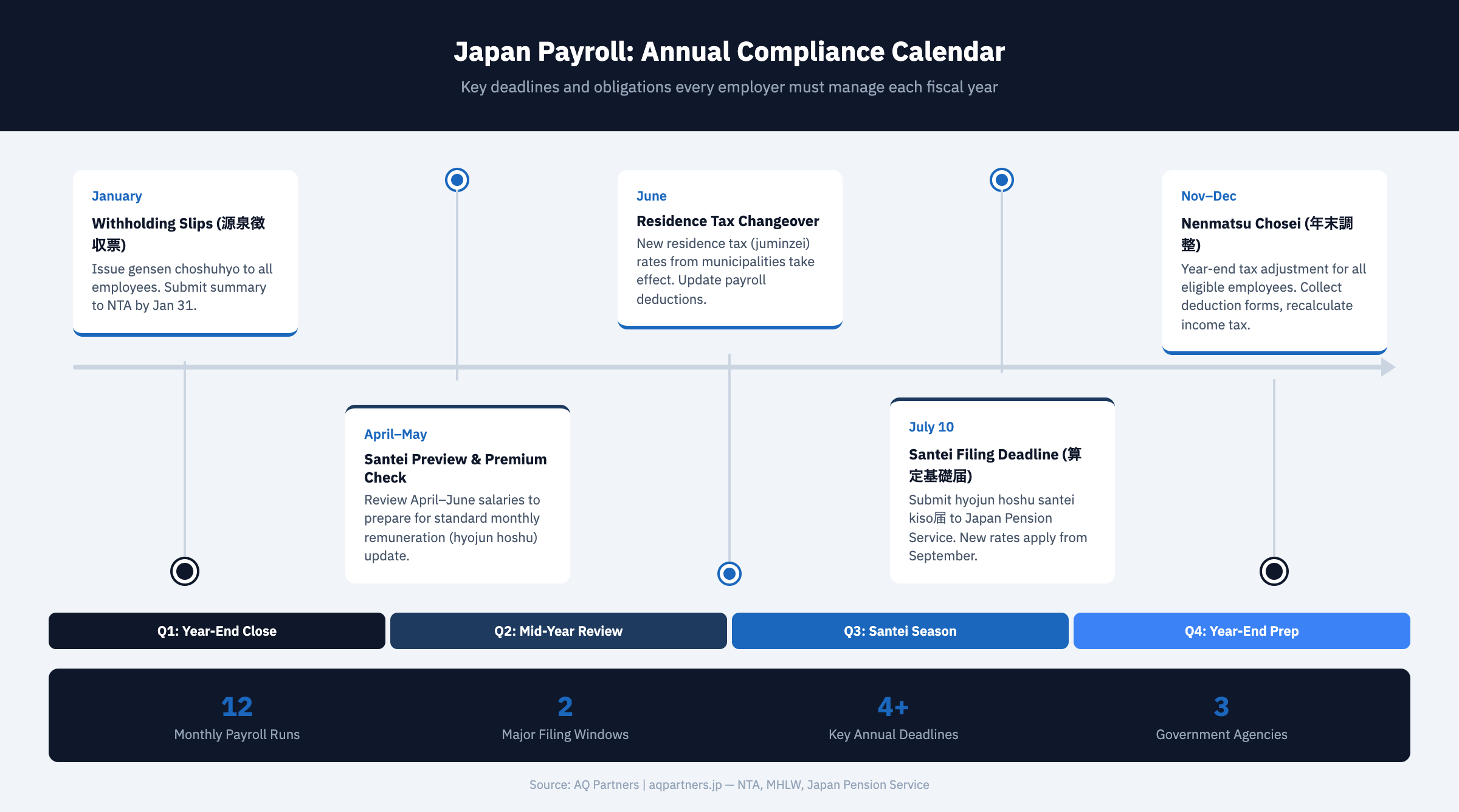
Japan payroll is not a monthly task with an annual footnote — it is a year-round operational program with significant obligations in every quarter. The table below maps each annual obligation to its period and required action.
| Period | Task | Action Required |
|---|---|---|
| January | Withholding payment slip distribution | Issue 源泉徴収票 (genzenchoshu hyo) to all employees by 31 January |
| January | Municipal residence tax reporting | Report prior-year income for all employees to each employee's municipality of residence |
| April | Social insurance annual review starts | Track April, May, and June salary data for santei (standard remuneration determination) calculation |
| June | New residence tax deductions begin | Apply new annual residence tax amounts from municipality notices to June payroll onwards |
| July | Santei filing deadline | Submit monthly remuneration determination (santeiki teishutsu) to the Japan Pension Service |
| June–July | Summer bonus processing | Calculate and pay summer bonus; social insurance premiums apply to bonus amounts |
| October–December | Nenmatsu chosei | Collect employee deduction declarations; recalculate annual income tax; refund or collect the difference in December payroll |
| December | Winter bonus processing | Calculate and pay winter bonus; withholding income tax applies to bonus amounts |
| Monthly (by 10th) | Social insurance + withholding remittance | Pay combined social insurance premiums to the Japan Pension Service and withheld income tax to the NTA |
The nenmatsu chosei process in October–December is the single largest annual payroll obligation. For a step-by-step operational guide to that workflow, see our dedicated post on Japan payroll compliance: social insurance and nenmatsu chosei.
Payroll for Foreign Employees
Foreign employees in Japan are subject to the same payroll processing cycle as Japanese nationals, but with additional considerations that affect tax withholding and social insurance enrollment.
Tax residency status is the primary variable: an employee who has been resident in Japan for less than one year and has no intention to reside long-term is classified as a non-resident for income tax purposes, and withholding tax applies differently — specifically at a flat 20.42% on Japan-source income, rather than using the progressive withholding tables. Most foreign employees who remain in Japan beyond one year become residents and are taxed like Japanese nationals. Japan has totalization agreements with 23 countries that allow employees seconded from those countries to remain in their home-country social insurance system and avoid dual enrollment — the JETRO Business Setup Guide provides relevant context for foreign companies establishing Japan operations. My Number (individual identification number) registration is required for all employees working in Japan, including non-Japanese nationals, and must be in place before payroll can be processed. For a comprehensive guide to all aspects of payroll for foreign employees in Japan, see our dedicated post on Japan payroll for foreign employees.
Setting Up Payroll for a New Japan Entity
Before the first payroll run, a newly incorporated Japan entity must complete statutory registrations with four separate government offices — each registration has its own documentation requirements and processing timeline.
The four registrations are: (1) the Japan Pension Service office (nenkin jimusho), to enroll the company in the shakai hoken system for health insurance and employees' pension; (2) the relevant health insurance association, which may be the Japan Health Insurance Association (Kyokai Kenpo) or an industry-specific health insurance society depending on the company's industry; (3) the Labor Standards Inspection Office (rodo kijun kantoku sho), to register under the Labor Standards Act and set up workers' accident compensation insurance; and (4) the Hello Work public employment office, to register for employment insurance (koyo hoken). These registrations must be completed before the first employee's payroll is processed. Missing or delaying registrations results in retroactive premium assessments and potential penalties. For the full step-by-step entity setup checklist, see our guide on setting up payroll for a new Japan entity.
Choosing Payroll Software
Payroll software selection is a compliance decision, not just an operational one — the wrong platform will fail to handle Japan's statutory requirements natively.
Domestic platforms — SmartHR, freee HR, and MoneyForward Cloud Payroll — handle Japan compliance requirements out of the box, including social insurance calculation, nenmatsu chosei workflows, My Number management, and FB data bank transfer file generation. Global platforms — Workday, SAP SuccessFactors, ADP GlobalView — offer Japan coverage through localization modules, but implementation cost and the depth of Japan-specific compliance handling vary significantly and should be verified before deployment. For a full comparison of platforms by company size and use case, see our dedicated post on payroll software for Japan.
Frequently Asked Questions
What is the standard payroll payment date in Japan?
The 25th of the month is the dominant payroll payment date across Japanese companies. Japanese law does not mandate the 25th specifically, but requires that employers pay salary on a fixed date established in advance and stated in the company's work rules or employment contracts. Once set, the pay date cannot be changed unilaterally. If the 25th falls on a weekend or national holiday, the standard practice is to advance payment to the preceding business day. Companies may choose a different fixed date — typically the last day of the month or another date in the 20th–25th range — provided it is consistently applied and documented. The payment date must appear in the written statement of working conditions (rodojoken tsuchisho) provided to each employee at the time of hiring, as required by the Labor Standards Act.
Are bonuses subject to social insurance in Japan?
Yes. Since 2003, bonuses paid to employees enrolled in Japan's shakai hoken system are subject to social insurance contributions — both the employee share and the matching employer share. The social insurance contribution on bonuses is calculated on the actual bonus amount, capped at ¥1.5 million per payment for health insurance purposes and ¥1.5 million per month for pension purposes. Employment insurance premiums also apply to bonus payments at the same rate as monthly salary. In addition to social insurance, withholding income tax applies to bonus amounts. Bonuses are not subject to residence tax deduction at payment; they are included in the total annual income figure used to calculate residence tax for the following year. For employers paying discretionary summer and winter bonuses, accurate social insurance and withholding tax calculation on bonus payments is a mandatory part of the payroll cycle, not an optional step.
How long must payroll records be kept in Japan?
Japan's Labor Standards Act requires employers to retain payroll-related records — including wage ledgers (chingin daiccho), worker rosters (rodo sha meibo), and attendance records — for five years from the date of creation. In practice, many compliance advisors recommend retaining records for seven years to align with the My Number Act's retention requirement for identification-related records and the National Tax Agency's standard tax record retention period. The seven-year standard also aligns with the corporate tax record retention requirement under Japan's tax laws. Payslip data, social insurance filing records, and nenmatsu chosei forms should all be retained for a minimum of seven years. Cloud payroll platforms typically provide data archiving features that enforce retention periods and support compliant deletion at the end of the required period. The National Tax Agency (NTA) provides official guidance on record retention requirements for income tax and withholding tax purposes.
Can a foreign company pay employees in Japan without a local entity?
A foreign company without a Japan legal entity cannot legally employ workers directly in Japan on a long-term basis. Without a local entity, the company cannot register with Japan's social insurance and labor insurance systems, cannot withhold and remit income tax as an employer, and cannot enter into employment contracts that comply with Japan's Labor Standards Act. The primary alternative is the Employer of Record (EOR) model, in which a licensed Japan entity acts as the legal employer for the workers and handles all payroll, social insurance, and labor law compliance on behalf of the foreign company. This is a common route for companies that want to test the Japan market or hire a small number of people before investing in a full entity setup. For an assessment of whether an EOR arrangement or a local entity is appropriate for a given situation, the JETRO Business Setup Guide provides an overview of establishment options. For HR compliance considerations for global teams operating in Japan, see our guide on Japan HR compliance strategies for global teams.
Setting Up or Auditing Your Japan Payroll Operation
Japan payroll is one of the most operationally demanding compliance functions for foreign companies in the Asia-Pacific region. The combination of employer-administered year-end tax adjustment, dual social insurance systems, FB data bank transfer requirements, mandatory payslip issuance, and a year-round calendar of filings and deadlines means that payroll cannot be managed on an ad-hoc basis — it requires a structured, system-supported process from day one.
AQ Partners provides payroll setup, social insurance registration, nenmatsu chosei administration, and ongoing monthly payroll processing for foreign companies in Japan. Whether you are configuring payroll for a new entity, auditing an existing operation for compliance gaps, or selecting a payroll platform, AQ Partners provides operational and compliance support tailored to the Japan market.
Ready to set up or audit your Japan payroll operation? Contact AQ Partners →


Yuga Koda is a founding Director at AQ Partners, supporting foreign companies, funds, and families operating in Japan. His experience operating companies in both Japan and international markets gives him a practical understanding of back office operations from both sides.