
Japan Tax Filing Schedule: Important Dates You Can't Miss


Key Takeaways
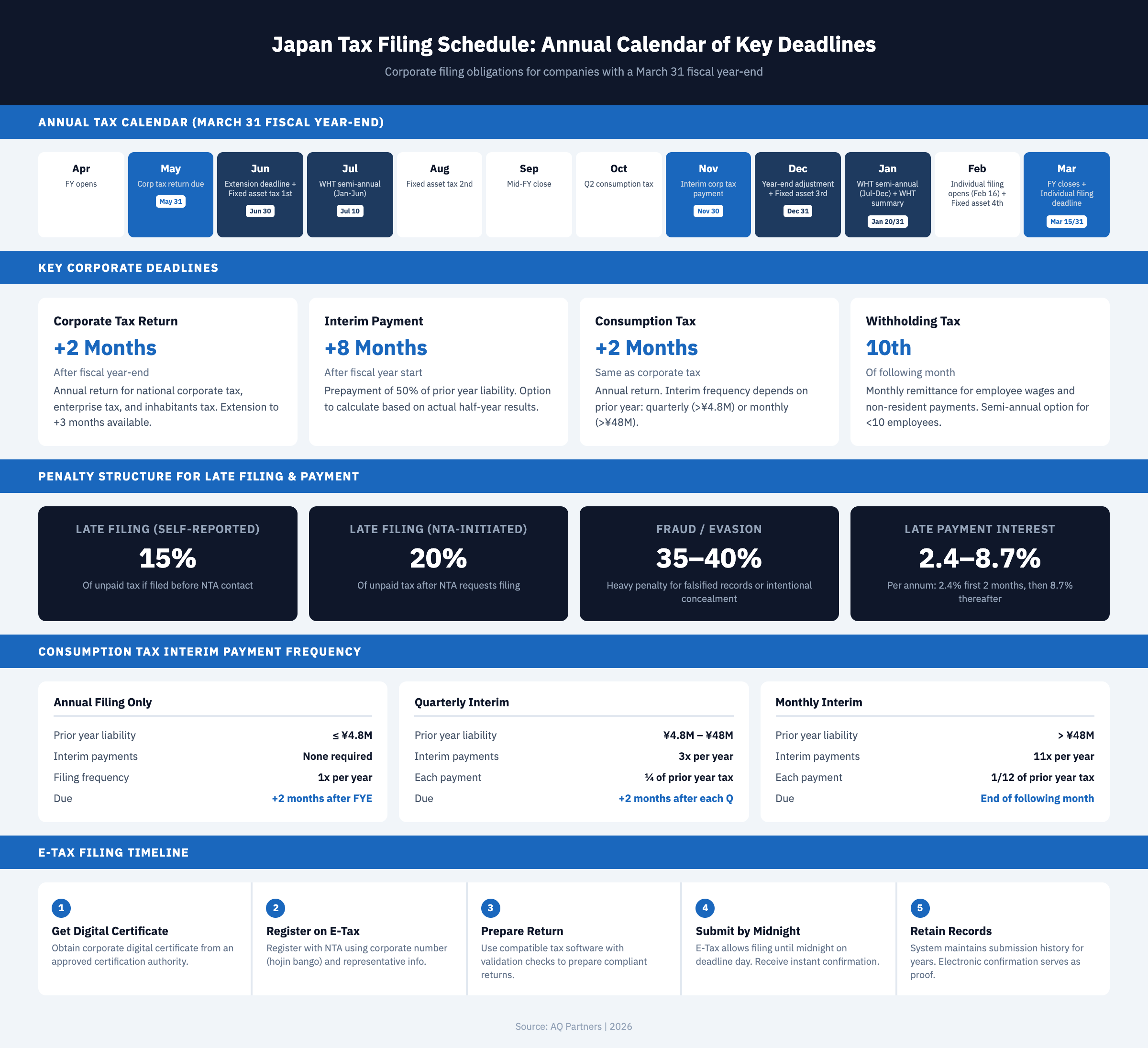
- Most corporate tax deadlines fall two months after fiscal year-end — the annual corporate tax return, consumption tax return, and residence tax return all share this deadline, making the two-month mark the single most critical date on the Japanese tax calendar.
- Withholding tax requires monthly attention regardless of fiscal year — employers must remit withheld income tax by the 10th of the following month, though businesses with fewer than 10 employees can apply for semi-annual remittance to reduce this to two payments per year.
- Late filing penalties range from 15% to 40% of unpaid tax — the National Tax Agency (NTA) imposes a 15% penalty for self-reported late filings, 20% after NTA contact, and 35–40% for fraud, plus tiered interest of 2.4% for the first two months rising to 8.7% per annum thereafter.
- Consumption tax interim payments vary by prior-year liability — companies with prior-year consumption tax above ¥4.8 million must pay quarterly, and those above ¥48 million must pay monthly, requiring careful cash flow planning throughout the year.
- Filing extensions add one month for returns but not for payment — corporations can extend their filing deadline from two to three months after fiscal year-end, but estimated tax must still be paid by the original two-month deadline to avoid interest charges starting at approximately 2.4% per annum.
How Japan's Tax Filing Calendar Works
Japan's tax filing system operates on multiple overlapping schedules determined by tax type, entity structure, and business size. While individuals follow the calendar year (January 1 to December 31) for income tax purposes, corporations can choose any consecutive 12-month period as their fiscal year. Most Japanese companies select March 31 as their fiscal year-end, aligning with the traditional business and academic calendar. Foreign subsidiaries often choose December 31 to match their parent company's reporting period. Your chosen fiscal year-end determines when the majority of corporate tax obligations come due, as deadlines are calculated as a specific number of months after your fiscal year closes.
According to the NTA's corporate tax guidance, maintaining compliance across these overlapping obligations requires a structured tax calendar specific to your company's fiscal year. Missing any deadline can result in penalties ranging from 5% to 40% of unpaid tax, depending on the severity and nature of the delay. Beyond financial penalties, late filings can damage your company's reputation with tax authorities and potentially trigger more frequent audits. Timely tax compliance is also a requirement for maintaining good standing with banks, investors, and business partners in Japan — many financial institutions review tax compliance records when making lending decisions. These filings are just one piece of the broader back office infrastructure you need when entering the Japanese market.
Your entity structure influences fiscal year and compliance decisions, as KK (kabushiki kaisha), GK (godo kaisha), and branch offices each have different considerations. Approximately 70% of Japanese corporations use a March 31 fiscal year-end, making May the busiest month for corporate tax filings nationwide and creating high demand for accounting resources during this period. This flexibility allows corporations to distribute their tax compliance workload throughout the year rather than competing for resources during peak periods.
Corporate Tax Return Deadlines and Extensions
The cornerstone of corporate tax compliance in Japan is the annual corporate tax return, which must be filed within two months of your fiscal year-end. For example, if your fiscal year ends on March 31, your corporate tax return is due by May 31. This deadline applies to both national corporate tax and local corporate taxes, including enterprise tax and inhabitants tax. The return is comprehensive and requires detailed financial statements, tax calculations, and supporting schedules. Most corporations work with certified public tax accountants (zeirishi) to prepare these returns, as the complexity of Japanese tax law makes accurate self-preparation challenging for all but the smallest businesses.
Proper chart of accounts management throughout the year makes annual filing significantly smoother. According to PwC's Worldwide Tax Summaries, the effective corporate tax rate (combining national and local taxes) ranges from approximately 29% to 31% for standard corporations, though SMEs with paid-in capital of ¥100 million or less qualify for reduced rates on the first ¥8 million of taxable income. Corporate tax rates vary depending on company size, income level, and location — the national rate has decreased from above 30% over the past decade as Japan works to enhance international competitiveness. For a detailed breakdown of rates and calculations, see our guide to corporate income tax rates in Japan.
Filing Extensions
Corporations can apply for a one-month extension, moving the filing deadline to three months after fiscal year-end. The application must be submitted to the local tax office before the original two-month deadline, with valid reasons such as pending shareholder approval or complex international transactions. The extension applies only to filing — estimated tax payment is still due at the original two-month mark. Underpayments accrue interest at approximately 2.4% per annum for the first two months, increasing to approximately 8.7% thereafter. Understanding these deadlines is particularly important for newly incorporated companies navigating post-incorporation filing requirements.
Interim Corporate Tax Payments
In addition to the annual filing, most corporations must make an interim corporate tax payment at the six-month mark of their fiscal year. This prepayment is due within two months of the end of the first six-month period. For instance, if your fiscal year runs from April 1 to March 31, your interim payment is due by November 30. The interim payment amount is typically calculated as half of the previous year's total corporate tax liability. Alternatively, corporations can choose to file an interim tax return based on actual results for the first six months, which may be beneficial if current-year profits are significantly lower than the previous year. Interim payments apply to national corporate tax, local corporate inhabitants tax, and enterprise tax, and are credited against the final tax liability when the annual return is filed. Any overpayment is either refunded or carried forward to the next period.
Consumption Tax and Withholding Tax Schedules
Consumption tax (shohi zei), Japan's equivalent of value-added tax (VAT), is currently set at 10% for most goods and services, with a reduced 8% rate for certain food items and newspapers. Corporations subject to consumption tax must file an annual consumption tax return within two months of their fiscal year-end, the same deadline as corporate income tax. Not all businesses are required to file consumption tax returns — small businesses with taxable sales below ¥10 million in the base period (typically two years prior) are generally exempt from consumption tax obligations, though they can voluntarily register as taxable entities if it is advantageous for their business. The consumption tax return calculates the difference between consumption tax collected on sales and consumption tax paid on purchases. If you have collected more tax than you have paid, you remit the difference to the tax authorities. Conversely, if you have paid more than collected — common for exporters or businesses with large capital expenditures — you can claim a refund.
Consumption Tax Interim Payments
Consumption tax also has interim payment requirements, with the frequency determined by your previous year's tax liability. The interim payment schedule is designed to ensure steady tax revenue throughout the year and reduce the burden of a single large year-end payment. If your previous year's consumption tax liability exceeded ¥4.8 million but was less than ¥48 million, you must make quarterly interim payments, due within two months after the end of each three-month period. Companies with consumption tax liability exceeding ¥48 million in the previous year must make monthly interim payments, due by the last day of the month following each one-month period. The amount of each interim payment is typically one-quarter (for quarterly filers) or one-twelfth (for monthly filers) of the previous year's annual consumption tax liability. Companies can also elect to calculate interim payments based on actual results for each period rather than using the previous year's figures — this option requires filing an interim return for each period and can be beneficial during periods of declining sales or increased deductible expenses.
Withholding Tax (Monthly and Semi-Annual)
One of the most frequent tax obligations for Japanese corporations is withholding tax on employee salaries and payments to certain vendors. Employers must withhold income tax from employee wages and remit it to the tax authorities by the 10th day of the month following payment. For example, withholding tax on January salaries must be paid by February 10. This monthly obligation applies to withholding on employee salaries, bonuses, and certain payments to non-employees such as professional fees paid to lawyers, tax accountants, and other service providers. The withholding rates vary depending on the type of payment and the recipient's tax status. For non-resident individuals and foreign corporations receiving payments from Japanese sources, withholding tax rates are typically 20.42% unless reduced by an applicable tax treaty. For companies building teams in Japan, these obligations are part of broader HR compliance requirements.
Recognizing the administrative burden of monthly withholding tax remittance on small businesses, the Japanese tax system offers a semi-annual payment option. This special provision, known as the Noki no Tokurei (special provision for payment deadlines), is available to businesses with fewer than 10 employees who regularly receive salary payments. Under this option, eligible employers can remit withheld taxes twice annually rather than monthly: withholding from January through June is due by July 10, and withholding from July through December is due by January 20 of the following year. To use this option, you must submit an application form to your local tax office. Once approved, the authorization remains in effect until you notify the tax office of changes or exceed the employee threshold.
The year-end tax adjustment (nenmatsu chosei) is a separate reconciliation process for employee withholding tax. Employers must review the total withholding from each employee throughout the calendar year, compare it to their actual annual tax liability, and either refund excess withholding or collect any shortfall. This process must be completed by the end of December, typically with the December salary payment. The final reconciliation documents and withholding tax summary must be submitted to the tax office by January 31 of the following year, and each employee must receive a withholding slip (gensen choshu-hyo) showing their annual income and withheld taxes.
Other Regular Tax Obligations and Individual Filing
Beyond corporate tax, consumption tax, and withholding tax, several other recurring obligations require careful tracking throughout the fiscal year.
Fixed Asset Tax and Residence Tax
Fixed asset tax (kotei shisan zei) is a municipal tax levied on real property and depreciable business assets owned as of January 1 each year. Unlike national taxes, fixed asset tax is administered by local governments, and rates vary by municipality, though they typically hover around 1.4% of the assessed value. Tax notices are generally sent out in April or May, and payment is typically divided into four installments — the common schedule is late April or early June for the first installment, late July or early August for the second, late December for the third, and late February for the fourth. The tax applies not only to land and buildings but also to machinery, equipment, and other tangible business assets with acquisition costs exceeding certain thresholds. For details on how asset categories affect both depreciation and fixed asset tax obligations, see our guide on tax depreciation in Japan.
Corporate residence tax (hojin juminzei) consists of two components: a per-capita levy based on your company's capitalization and employee count, and an income-based levy calculated as a percentage of your national corporate tax. The filing deadline for corporate residence tax aligns with your corporate tax return deadline — within two months of fiscal year-end (or three months if you have obtained an extension). Different municipalities may have slightly different rates and calculation methods, so corporations with offices in multiple locations must carefully track their obligations in each jurisdiction. Tokyo, for instance, has different rates than other prefectures, and rates can also vary between cities within the same prefecture.
Individual Income Tax Filing
While this guide focuses primarily on corporate tax obligations, individuals who own businesses or have certain income sources must also file annual income tax returns. The individual income tax filing period, known as kakutei shinkoku, runs from February 16 to March 15 each year for the previous calendar year's income. This deadline is particularly relevant for corporate executives who receive income from multiple sources, foreign nationals working in Japan, individual business owners, and landlords with rental income. Employees whose sole income is salary from a single employer and who have completed year-end adjustment typically do not need to file.
Foreign residents and non-residents with Japanese-source income have specific filing requirements. Permanent residents must report worldwide income, while non-permanent residents report Japanese-source income and foreign-source income paid in or remitted to Japan. Individuals whose previous year's income tax exceeded certain thresholds must make estimated tax payments (yotei nozei) in two installments: the first due by July 31 and the second by November 30. These prepayments are credited against the final tax liability when the annual return is filed, with any balance due by March 15 or any overpayment refunded.
Summary of Key Tax Filing Deadlines
The following table provides a quick-reference overview of all major tax filing deadlines. All corporate deadlines assume a March 31 fiscal year-end unless otherwise noted.
| Filing Type | Deadline | Notes |
|---|---|---|
| Annual Corporate Tax Return (National & Local) | Within 2 months of fiscal year-end (e.g., May 31 for March FYE) | One-month filing extension available upon application; payment still due at original deadline |
| Interim Corporate Tax Payment | Within 2 months of the mid-fiscal-year point (e.g., Nov 30 for April–March FY) | Typically 50% of prior year liability; option to file based on actual interim results |
| Annual Consumption Tax Return | Within 2 months of fiscal year-end (same as corporate tax) | Exempt if base-period taxable sales are below ¥10 million; quarterly or monthly interim payments may apply |
| Consumption Tax Interim Payments (Quarterly) | Within 2 months after each quarter-end | Required if prior year liability exceeded ¥4.8M but was under ¥48M |
| Consumption Tax Interim Payments (Monthly) | By the last day of the following month | Required if prior year liability exceeded ¥48M |
| Withholding Tax (Monthly Remittance) | By the 10th of the month following salary payment | Applies to employee wages, bonuses, and payments to non-resident service providers |
| Withholding Tax (Semi-Annual Option) | Jul 10 (for Jan–Jun) and Jan 20 (for Jul–Dec) | Available only to employers with fewer than 10 employees; requires prior approval |
| Corporate Residence Tax | Within 2 months of fiscal year-end (aligned with corporate tax) | Rates vary by municipality; interim payments required above certain thresholds |
| Fixed Asset Tax (Kotei Shisan Zei) | 4 installments: typically Jun, Aug, Dec, Feb (varies by municipality) | Assessed on property and depreciable assets owned as of January 1; rate approx. 1.4% |
| Year-End Tax Adjustment (Nenmatsu Chosei) | Completed by end of December; summary filed by January 31 | Reconciles employee withholding for the calendar year; withholding slips issued to employees |
| Individual Income Tax Return (Kakutei Shinkoku) | February 16 – March 15 (for previous calendar year) | Required for individuals with multiple income sources, side businesses, or salary exceeding ¥20M |
Penalties, Extensions, and E-Tax Filing
The Japanese tax system imposes several types of penalties for non-compliance, with severity increasing based on the nature and extent of the violation. The basic late filing penalty (mushinkoku kasanzei) is typically 15% of the unpaid tax amount for returns filed after the deadline but before the tax office contacts you. If the tax office initiates contact before you file, the penalty increases to 20%. For particularly serious cases involving deliberate concealment or tax evasion, a heavy additional penalty (jukasanzei) of 35% to 40% may be imposed on top of the base penalty. According to PwC's tax administration summary, these penalties apply on top of interest charges and can be imposed concurrently.
Beyond percentage-based penalties, interest charges (entaizei) accrue on unpaid tax amounts from the original due date until payment. The interest rate is adjusted periodically but generally consists of two tiers: a lower rate for the first two months after the deadline (currently around 2.4% annually) and a higher rate thereafter (around 8.7% annually). These rates apply to the outstanding tax balance and accrue daily until full payment is received. Interest charges are automatic and non-negotiable — unlike penalties, which may sometimes be reduced or waived under exceptional circumstances, interest represents the time value of money owed to the government and is consistently applied.
Filing extension requests must be submitted to the jurisdictional tax office before the original two-month deadline and can be filed in person, by mail, or through the e-Tax electronic filing system. The extension applies only to filing deadlines, not payment deadlines — even with an approved extension, you must estimate your tax liability and submit payment by the original deadline to avoid interest charges. Conservative estimation is advisable, as overpayments are refunded with interest while underpayments accrue additional charges.
The NTA's electronic filing system, known as e-Tax, has become increasingly sophisticated and offers several advantages over traditional paper filing. E-Tax allows filing until midnight on the deadline date rather than requiring submission during business hours at tax offices, provides electronic upload of supporting documentation, and offers immediate confirmation of receipt. Over 90% of corporate tax returns in Japan are now filed electronically, reflecting the system's maturity and the practical advantages it offers. Setting up e-Tax requires obtaining a corporate digital certificate (denshi shomeisho) from an approved certification authority and registering with the NTA using your corporate number (hojin bango). Many corporations use specialized tax software that integrates with e-Tax, including validation checks that identify potential errors before submission. Setting up your corporate bank account early also facilitates smoother electronic tax payment processing.
When to Seek Professional Help
While this guide provides a comprehensive overview of Japan's corporate tax filing schedule, the complexity of Japanese tax law means that most corporations benefit significantly from professional tax guidance. Consider engaging a certified public tax accountant (zeirishi) if your company has international transactions, operates in multiple jurisdictions, undergoes restructuring, or faces any unusual tax situations. A qualified zeirishi can help optimize your tax position, ensure accurate compliance with frequently changing regulations, and represent you in communications with tax authorities. The cost of professional tax services is generally far outweighed by the value of avoiding penalties, identifying legitimate tax savings opportunities, and maintaining good relationships with the NTA.
Building a tax calendar specific to your company's fiscal year and tax profile is highly recommended. Work with your accounting team to map out all deadlines at the beginning of each fiscal year, and set internal deadlines several weeks before official due dates to allow time for review and unexpected complications. Early consultation is particularly important when making significant business decisions such as choosing a fiscal year-end, establishing new subsidiaries, entering new business lines, or making large capital investments. For comprehensive guidance on managing Japan's corporate tax obligations, see our complete Japan corporate tax compliance guide.
Working with AQ Partners. Our Tokyo team provides annual tax filings and back office operations for foreign companies operating in Japan. Book a consultation to discuss your situation.

Yuga Koda is a founding Director at AQ Partners, supporting foreign companies, funds, and families operating in Japan. His experience operating companies in both Japan and international markets gives him a practical understanding of back office operations from both sides.