
Global vs. Domestic Payroll Software in Japan: Pros & Cons
Key Takeaways
- Japan payroll compliance is more penalty-prone than accounting — Errors in nenmatsu chosei, My Number handling, or social insurance calculations can trigger audits and fines from the Ministry of Health, Labour and Welfare (MHLW), not just tax adjustments.
- Domestic software is purpose-built for Japan's payroll rules — SmartHR, freee HR, and MoneyForward Cloud Payroll handle nenmatsu chosei, social insurance changes, and My Number out of the box with no additional configuration cost.
- Global payroll platforms are powerful for multi-country consolidation but often fall short on Japan specifics — Japan localization is typically an add-on module with implementation costs ranging from ¥3M to ¥30M or more, and local compliance gaps frequently remain.
- The hybrid model has become the default for mid-size multinationals — Combining a global HRIS such as Workday or SAP with a domestic payroll engine connected via API bridges group visibility and Japan compliance without sacrificing either.
- Selecting the wrong payroll platform in Japan carries real regulatory risk — Unlike an accounting mismatch that may surface at year-end, a payroll error affects every pay cycle, every employee, and every social insurance submission.
Choosing between global and domestic payroll software for a Japan entity is not simply a matter of cost or convenience. Payroll in Japan sits at the intersection of labor law, tax law, and social insurance regulation — all of which change regularly and carry penalties for non-compliance. This post examines the concrete pros and cons of each approach, the specific Japan-side requirements that most often trip up global platforms, and the hybrid model that a growing number of mid-size multinationals are using to manage both group-level visibility and local compliance. For a complete overview of payroll software options in Japan, see our payroll software Japan guide.
Why This Decision Is Harder for Payroll Than Accounting
Japan's payroll obligations are more operationally demanding than its accounting requirements — they recur every month, affect every employee, and are enforced by the MHLW with penalties that go beyond tax adjustments.
When foreign companies assess software for their Japan entity, accounting software often receives more scrutiny than payroll software. This order of priority is understandable — J-GAAP, consumption tax, and the Qualified Invoice System are visible compliance challenges. But in practice, payroll is the harder operational problem.
Japan payroll involves a recurring set of obligations that must be executed accurately on a fixed monthly schedule. Social insurance premiums — covering health insurance, pension, and employment insurance — are recalculated each September based on the standardized monthly remuneration (標準報酬月額) determined in April through June. These grade changes must be reflected in payroll deductions immediately and filed with the relevant social insurance office. Any error or delay triggers follow-up from the MHLW, the Japan Pension Service, or both.
Nenmatsu chosei (年末調整) — Japan's year-end tax adjustment — is a further obligation unique to Japan. Unlike countries where employees file their own tax returns, Japan places the burden of annual income tax reconciliation on the employer. HR and payroll teams must collect declarations from every employee, calculate individual tax adjustments, and reflect the results in the December payroll. The process is detailed, document-heavy, and cannot be skipped or approximated. The National Tax Agency (NTA) provides official guidance, but the operational execution falls entirely on the employer's payroll team or payroll software.
My Number — Japan's individual identification number system — adds a third layer of compliance. Every employee's My Number must be collected, verified, securely stored, and used correctly in social insurance filings and year-end tax documents. Data handling errors are a regulatory violation, not simply an administrative inconvenience.
For a detailed breakdown of these obligations, see our post on Japan payroll compliance: social insurance and nenmatsu chosei.
Domestic Payroll Software: Strengths
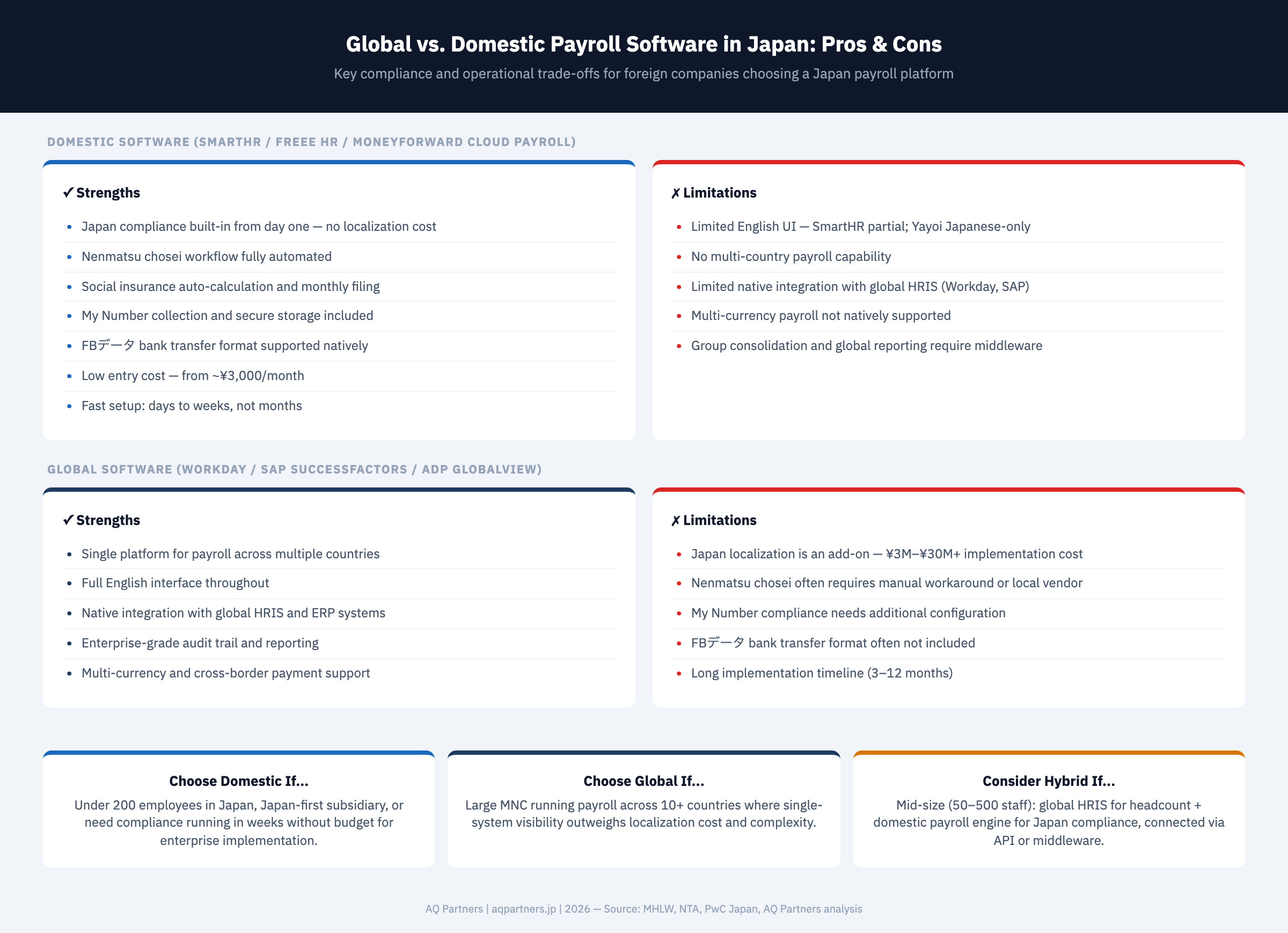
Japan's domestic payroll platforms are built from the ground up for local compliance — nenmatsu chosei, My Number, social insurance, and bank transfers are standard features, not add-ons.
The leading domestic payroll platforms — SmartHR, freee HR, and MoneyForward Cloud Payroll — were designed specifically for Japan's employment and payroll environment. Their core compliance features reflect this origin.
Nenmatsu chosei is handled natively. SmartHR and MoneyForward Cloud Payroll guide HR teams through the full year-end adjustment process: collecting employee declarations, calculating income tax adjustments per individual, and outputting the correct deduction amounts for the December pay run. This is not a workaround or an optional module — it is a central feature of the product.
Social insurance calculations are automated and updated when grade changes take effect each September. Monthly changes to standardized remuneration grades are applied to payroll deductions without manual intervention, and the required filings to the Social Insurance Office (年金事務所) are generated directly from the platform.
My Number compliance is built in. Employee My Number collection workflows, secure storage protocols, and correct usage in social insurance filings and withholding tax statements are standard features across the major domestic platforms.
Domestic platforms also support Japan's FBデータ (FB data) bank transfer format — the standardized file format required by Japanese banks for payroll disbursement. This allows payroll totals to be transferred directly to employees' accounts through domestic banking systems without manual data entry or file conversion.
Cost is a further advantage. Entry-level domestic payroll SaaS plans start from approximately ¥3,000 per month for small organizations and scale proportionally with headcount. For a Japan subsidiary with fewer than 100 employees, the total cost of ownership is typically a fraction of what a global platform's Japan localization module would cost to implement.
Domestic Payroll Software: Limitations
Domestic payroll platforms operate almost entirely in Japanese, offer limited integration with global HRIS and ERP systems, and have no meaningful multi-country capability.
The primary constraint of domestic payroll software for foreign companies is language. SmartHR has made meaningful progress on English-language interface support — it is the most accessible domestic platform for international HR teams — but even SmartHR's documentation, customer support, and more complex configuration workflows remain predominantly Japanese. Yayoi is entirely Japanese-language, making it unsuitable for organizations where the HR or payroll team is primarily English-speaking.
Integration with global HRIS platforms is a second significant limitation. Workday, SAP SuccessFactors, and similar enterprise HRIS systems have limited native connectors to domestic Japanese payroll engines. Data exchange — employee master records, organizational structure changes, headcount updates — typically requires middleware, custom API development, or manual export and import. This adds operational overhead and introduces data quality risk at the point of transfer.
Multi-currency support is absent. Domestic payroll platforms are designed for JPY payroll only. For organizations that compensate employees in multiple currencies, or that need to report payroll costs in a currency other than JPY, domestic platforms provide no native solution. Multi-country payroll consolidation is similarly out of scope — if an organization runs payroll across Japan, Singapore, and the United States, domestic Japanese software provides visibility only into the Japan component.
For strategies on managing Japan HR compliance within a global team structure, see our post on Japan HR compliance strategies for global teams.
Global Payroll Software: Strengths
Global payroll platforms provide a single system for multi-country payroll, a full English interface, and native connectivity to enterprise HRIS and ERP systems — making them the logical choice for large multinationals with significant headcount across multiple jurisdictions.
For organizations running payroll across ten or more countries, the operational case for a global payroll platform is clear. Platforms such as ADP GlobalView, Ceridian Dayforce, and Workday Payroll provide a unified view of global headcount, payroll costs, and compliance status across jurisdictions. Finance and HR leadership can report on total labor costs in the group's reporting currency, perform headcount analytics across entities, and manage intercompany allocations within a single system.
The English-language interface throughout the platform is a material advantage for international teams. HR business partners, finance controllers, and payroll administrators at headquarters can access Japan entity data, approve payroll runs, and review compliance status without requiring Japanese language capability.
Integration with global HRIS and ERP systems is a core design feature, not an afterthought. When Workday HRIS is the system of record for global headcount, connecting Workday Payroll or a global payroll platform to that system of record eliminates the manual data transfer that creates errors in hybrid setups. Similarly, payroll cost postings to SAP or Oracle Financials are handled through native integrations rather than manual journal entries.
Enterprise audit trail and controls are a further advantage. Global payroll platforms are designed to meet the internal control requirements of listed companies, including SOX compliance in the United States. Segregation of duties, approval workflows, and full audit trails for every payroll change are standard features.
Global Payroll Software: Limitations
Japan localization in global payroll platforms is consistently the weakest link — nenmatsu chosei often requires manual workarounds, My Number compliance needs additional configuration, and implementation costs can reach ¥30M or more before the Japan module is fully operational.
The most common failure point for global payroll platforms in Japan is nenmatsu chosei. The year-end tax adjustment is sufficiently unique to Japan's payroll and tax system that most global vendors have not built it as a native feature. Instead, organizations running a global platform for Japan payroll typically perform nenmatsu chosei calculations either manually in spreadsheets or with the help of a local payroll bureau — then reconcile the results back into the global system. This creates operational complexity and introduces compliance risk, particularly for organizations without experienced Japan payroll staff.
My Number compliance is not always fully handled by global platforms out of the box. The data collection, storage, and usage requirements associated with Japan's individual identification system require configuration and in some cases custom development within global platforms. Organizations must verify with their vendor exactly how My Number is handled before relying on the platform for compliance filings.
Japanese bank file formats are a practical obstacle. The FBデータ format used by Japanese banks for payroll disbursement is not universally supported by global payroll platforms. Where it is not supported, organizations must maintain a separate process for generating and submitting bank transfer files — adding a manual step to every pay cycle.
Implementation cost is the most visible limitation. A Japan localization module for a global payroll platform typically costs between ¥3M and ¥30M to implement, depending on the platform, the complexity of the Japan operation, and the extent of customization required. Implementation timelines commonly run six to twelve months. For a Japan subsidiary with fewer than 200 employees, this cost structure is rarely proportionate to the operational benefit. PwC Japan Tax Summaries provides useful reference context on the underlying tax obligations that drive these localization requirements.
The Hybrid Model
The hybrid model — a global HRIS such as Workday or SAP SuccessFactors as the system of record for headcount, connected via API or middleware to a domestic payroll engine such as SmartHR or MoneyForward Cloud Payroll — is how the majority of mid-size multinationals with Japan operations actually run their payroll today.
The logic of the hybrid model reflects the real-world constraints on both sides. A global HRIS provides the single source of truth for organizational structure, employee master data, and headcount reporting across all jurisdictions. A domestic payroll engine handles the Japan-specific calculations, compliance filings, and bank disbursements that global platforms consistently struggle with. The two systems are connected via API integration or middleware — allowing employee data to flow from the global system into the domestic payroll engine, and payroll cost data to flow back for consolidation reporting.
The connection architecture varies by platform and budget. Some organizations use purpose-built integration middleware. Others rely on scheduled data exports from the global HRIS and imports into the domestic payroll platform. A smaller number have invested in custom API integrations that synchronize data in near real time. The right approach depends on the frequency of employee data changes, the tolerance for manual reconciliation, and the IT resources available to maintain the integration.
The hybrid model is particularly well-suited to organizations in the 50 to 500 employee range in Japan. At this scale, the Japan operation is large enough to justify a dedicated payroll platform with full compliance features, but not large enough to justify the cost and complexity of a fully localized global payroll module. The JETRO Business Setup Guide provides useful background on the employment and payroll obligations that apply from the moment a Japan entity is established.
For organizations that are still deciding whether to establish a Japan entity at all — and considering an employer of record arrangement as an alternative — see our post on EOR vs. entity in Japan.
Global vs. Domestic Payroll Software: Side-by-Side Comparison
| Criterion | Domestic (SmartHR, freee HR, MoneyForward) | Global (ADP, Workday, SAP SuccessFactors) |
|---|---|---|
| Japan compliance out of box | Yes — fully native, no additional configuration | Partial — Japan localization module required; gaps common |
| Nenmatsu chosei | Built in; guided workflow for year-end adjustment | Often requires manual workaround or local vendor |
| My Number management | Native collection, storage, and filing workflows | Requires additional configuration; varies by vendor |
| Social insurance calculation | Automated; September grade changes handled natively | Inconsistent; often requires manual update or local support |
| English UI | Limited; SmartHR has partial English; Yayoi Japanese-only | Full English throughout |
| Bank transfer format | FBデータ format fully supported | Not always included; may require separate process |
| Implementation cost | Low; from ~¥3,000/month, minimal setup cost | High; ¥3M–¥30M+ for Japan module implementation |
| Setup time | Weeks; standard configuration for most use cases | Months to over a year for full Japan localization |
| Multi-country payroll | Not supported; Japan-only | Core strength; single platform across all jurisdictions |
| Best for | Japan-only or Japan-primary operations up to ~200 employees | Large MNCs running unified payroll across 10+ countries |
The Verdict: When to Choose Each
The right payroll software for a Japan entity depends primarily on three factors: the size of the Japan headcount, the number of countries in which the organization runs payroll, and the extent to which the Japan operation must report into a global HRIS or ERP.
Choose Domestic Payroll Software If:
- Your Japan entity has fewer than 200 employees and Japan is the only or primary payroll jurisdiction
- You are a foreign subsidiary establishing Japan operations for the first time and need compliant payroll running within weeks, not months
- Cost efficiency is a priority and a ¥3M–¥30M implementation budget for a Japan localization module is not justified at your current scale
- Your HR team in Japan includes Japanese-speaking staff who can operate the platform and manage compliance filings directly
- Full nenmatsu chosei, social insurance, and My Number compliance without manual workarounds is a non-negotiable requirement
Choose Global Payroll Software If:
- Your organization runs payroll across ten or more countries and requires a single consolidated view of global payroll costs and headcount
- Your finance and HR leadership at headquarters require real-time access to Japan payroll data in English within the group's existing ERP or HRIS
- You have the implementation budget and timeline to engage a Japan-specialist implementation partner to configure the localization module correctly
- Internal control requirements — such as SOX compliance — make enterprise-grade audit trails and segregation of duties mandatory
Choose the Hybrid Model If:
- Your Japan operation is in the 50 to 500 employee range — large enough to need a dedicated payroll platform, but not large enough to justify full global platform localization
- Your headquarters uses Workday, SAP SuccessFactors, or a similar global HRIS as the system of record for headcount and organizational structure, but Japan payroll compliance is too complex to run natively in that platform
- You need both group-level payroll cost visibility and full Japan-side compliance, and are willing to invest in API or middleware integration to connect the two systems
- You want to preserve optionality — starting with a domestic payroll engine and adding global integration as the Japan operation scales
For further reading on the specific platforms available in the Japan market, see our post on the best payroll software in Japan: SmartHR, freee, and MoneyForward.
How AQ Partners Can Help
AQ Partners provides payroll and back-office services for foreign companies operating in Japan. For organizations navigating the global versus domestic payroll software decision, we offer structured advisory support — from platform selection and implementation planning through to ongoing payroll processing and compliance management.
Our services cover software selection advisory, domestic payroll platform setup and configuration, nenmatsu chosei execution, social insurance filing coordination, My Number compliance, and headquarters reporting packages. Whether you are establishing Japan payroll for the first time or looking to bring structure to an existing operation, we can help you identify and implement the right approach for your entity's size, structure, and compliance obligations.
Need help choosing payroll software for your Japan entity? Contact AQ Partners →


Yuga Koda is a founding Director at AQ Partners, supporting foreign companies, funds, and families operating in Japan. His experience operating companies in both Japan and international markets gives him a practical understanding of back office operations from both sides.