
The Complete Guide to Japan Work Visas


Key Takeaways
- ✓Japan's work visa system has 29 residence statuses, but most business hires fall under just four categories — Engineer/Specialist in Humanities/International Services, Highly Skilled Professional (HSP), Intra-Company Transferee, and Business Manager cover the vast majority of corporate hiring scenarios.
- ✓The Certificate of Eligibility (COE) is the critical first step — employers in Japan file the COE application with regional immigration, and processing typically takes 1-3 months, with incomplete documentation being the leading cause of delays and rejections.
- ✓Employer sponsorship carries ongoing legal obligations — sponsoring companies must maintain proper employment contracts, report changes within 14 days, ensure salary parity with Japanese nationals, and retain immigration documentation for the duration of employment.
- ✓HSP status offers the fastest path to permanent residence — while standard work visas require 10 years of residence for PR eligibility, Highly Skilled Professionals with 80+ points can apply in just 1 year, making it a powerful retention tool for senior talent.
- ✓The total timeline from job offer to start date is typically 2-4 months — companies that prepare documentation in advance and understand common rejection reasons can significantly reduce processing time and avoid costly hiring delays.
Introduction
Japan's work visa system is the gateway to building an international workforce in Japan, and understanding it from end to end — categories, sponsorship, COE process, renewals — is essential for any company hiring foreign talent.
Whether you're a startup expanding into the Japanese market or an established enterprise building a local team, understanding Japan's work visa system is critical for successful hiring and compliance. According to the Immigration Services Agency of Japan (ISA), Japan's foreign resident population reached 3.59 million as of the end of 2024 — a record high and an 11.1% year-over-year increase. Work-related residence statuses accounted for approximately 36% of all foreign residents, reflecting growing demand for international talent.
This guide walks you through everything your business needs to know about Japan work visas — from visa categories and the Certificate of Eligibility process to renewals and ongoing compliance. The Ministry of Foreign Affairs (MOFA) maintains the official visa information portal, while the ISA administers the residence status system within Japan. For a deeper dive into selecting the right category for specific hiring scenarios, see our companion article on how to choose the right Japan work visa category.
Understanding Japan's Work Visa Categories
Status of Residence vs. Visa
A "visa" grants entry to Japan, while a "status of residence" determines what activities a foreign national can perform once inside the country — and employers must understand both.
A visa is permission to enter Japan, issued by a Japanese embassy or consulate abroad. Once entry is complete, the visa's purpose is fulfilled. A status of residence (在留資格, zairyu shikaku) is what actually authorizes a foreign national to live and work in Japan. It determines permissible activities, duration of stay, and applicable conditions. For employers, this distinction matters because sponsorship obligations primarily relate to the status of residence — ensuring that your employee's activities remain within the scope of their authorized status.
Main Work Visa Categories
Japan offers 29 residence statuses under the Immigration Control and Refugee Recognition Act, but four categories cover the vast majority of business hires.
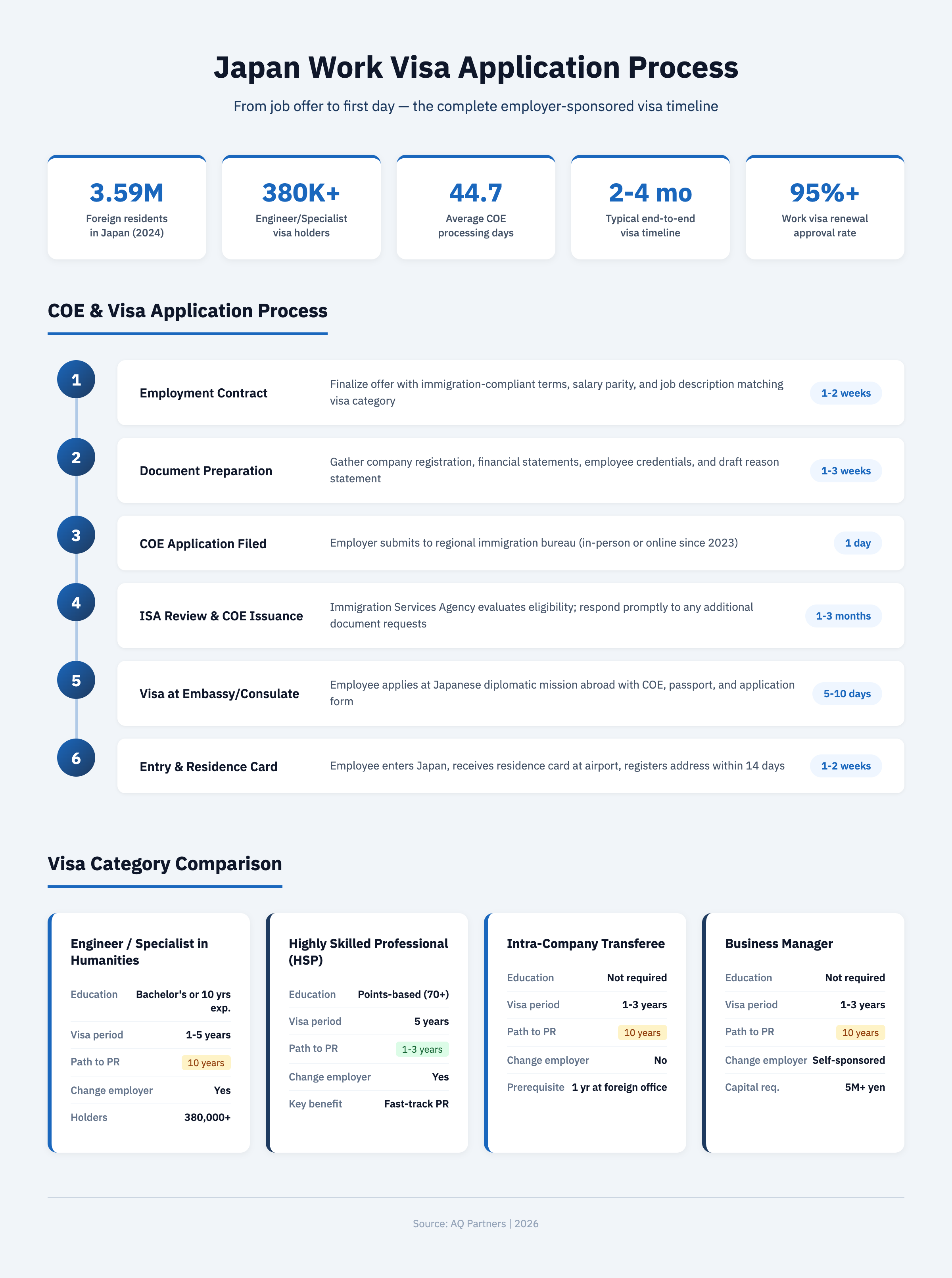
Engineer/Specialist in Humanities/International Services is the most common work visa, covering software engineers, accountants, marketers, consultants, translators, and language teachers. According to ISA statistics, this category accounted for over 380,000 holders as of the end of 2024. Requirements include a bachelor's degree (or 10 years of relevant experience), and salary equal to or above what a Japanese national would receive in the same role.
Highly Skilled Professional (HSP) uses a points-based system evaluating education, work experience, salary, age, and achievements. Applicants scoring 70+ points receive preferential treatment including 5-year visa duration and an accelerated path to permanent residence — 3 years at 70 points, or just 1 year at 80+ points. The ISA's HSP points calculation tool (moj.go.jp) helps employers pre-assess candidate eligibility.
Intra-Company Transferee enables internal transfers from a foreign office to a Japan entity within the same corporate group. The key advantage is no education requirement — the employee needs only 1+ years of continuous employment with the foreign entity. However, the holder cannot change employers in Japan without switching to a different visa status.
Business Manager covers entrepreneurs and senior executives with genuine management authority. Following 2024 reforms, requirements include a physical office in Japan, at least two full-time employees or capital investment of 5 million yen or more, and a viable business plan. This is the appropriate visa for representative directors of newly established Japanese entities.
| Visa Category | Best For | Key Requirements | Visa Period | Path to PR |
|---|---|---|---|---|
| Engineer/Specialist in Humanities/International Services | Software engineers, accountants, marketers, translators, designers | Bachelor's degree or 10 yrs experience; salary parity | 1 or 3 yrs (5 yrs on renewal) | 10 years |
| Highly Skilled Professional (HSP) | Senior executives, PhD holders, high earners (10M+ yen) | 70+ points on HSP scale; extensive documentation | 5 years | 1-3 years |
| Intra-Company Transferee | Internal transfers, global mobility, employees without degrees | 1 yr employment at foreign entity; proven corporate relationship | 1 or 3 yrs | 10 years |
| Business Manager | Entrepreneurs, representative directors, senior management | Office in Japan; 2 employees or 5M+ yen capital; business plan | 1 or 3 yrs | 10 years |
| Skilled Labor | Chefs (foreign cuisine), artisans, gemstone processors, pilots | 10 yrs experience in specialized trade (varies by field) | 1 or 3 yrs | 10 years |
| Specified Skilled Worker (SSW i) | Hospitality, food service, agriculture, construction, nursing care | Pass skills exam + JLPT N4 or equivalent; registered support plan | 1 yr (max 5 cumulative) | No direct path |
| Specified Skilled Worker (SSW ii) | Experienced workers in construction, shipbuilding, and expanding sectors | Pass advanced skills exam; supervisor-level proficiency | 1 or 3 yrs (renewable) | 10 years |
| Researcher | R&D researchers at private companies, public institutions | Contract with research institution; relevant qualifications | 1 or 3 yrs (5 yrs on renewal) | 10 years |
Employer Sponsorship Requirements
Sponsoring a work visa in Japan means the employer — not the employee — bears primary responsibility for the application, documentation, and ongoing compliance, making it essential to understand your obligations before extending an offer.
Legal Obligations
Under Japan's immigration framework, the sponsoring company must demonstrate that it is a legitimate, operating business with the financial capacity to employ foreign workers. Key obligations include:
- Employment contract alignment — the job description, salary, and working conditions in the employment contract must match the visa category. Immigration reviews contracts for consistency.
- Salary parity — foreign employees must receive compensation equal to or greater than a Japanese national in an equivalent position. Below-market salaries are a common rejection trigger.
- Change reporting — employers must notify immigration within 14 days of any material changes, including employee termination, resignation, or significant changes in job duties.
- Tax and social insurance compliance — companies must demonstrate enrollment in all mandatory programs. For details on employment obligations, see our Japan labor compliance risks guide.
Required Business Documentation
Documentation requirements vary by company category. The ISA classifies sponsoring companies into four categories based on size, listed status, and compliance track record:
- Category 1 — publicly listed companies, government entities. Minimal documentation required.
- Category 2 — companies withholding 15 million yen or more in annual employee taxes. Moderate documentation.
- Category 3 — companies with established tax filing history but below Category 2 thresholds. Standard documentation including financial statements.
- Category 4 — newly established companies or those without tax filing history. Most extensive documentation required, including detailed business plans and financial projections.
Newly established entities — common in Japan market entry scenarios — fall into Category 4 and face the highest documentation burden. Preparing thorough financial projections and a convincing business rationale is essential. As the company builds a compliance track record through timely tax filings and successful visa sponsorship history, it can move up to Category 3 or 2, substantially reducing future documentation requirements.
Financial and Compliance Prerequisites
Beyond documentation, immigration evaluates whether the sponsoring company can sustain the employment. Key financial indicators include:
- Business stability — companies with positive net assets and consistent revenue are viewed more favorably. Newly established companies should provide realistic financial projections covering at least the first year of operations.
- Payroll capacity — the offered salary must be demonstrably sustainable given the company's financial position. Immigration may question offers that appear disproportionate to company revenue.
- Social insurance enrollment — companies must be enrolled in Japan's mandatory social insurance programs (health insurance, pension, employment insurance, workers' compensation). Failure to enroll is a red flag that can affect visa applications.
- Tax compliance record — withholding tax certificates and corporate tax filings serve as evidence of legitimate business operations and are required for Category 2 and 3 company classifications.
The Certificate of Eligibility (COE) Process
The Certificate of Eligibility is the foundation of every Japan work visa application — it is filed by the employer in Japan, takes 1-3 months to process, and its approval largely determines whether the visa will be granted.
The COE Explained
A Certificate of Eligibility (COE) is a document issued by the Immigration Services Agency (ISA) that pre-certifies a foreign national's eligibility for a specific residence status. While not technically mandatory, having a COE dramatically simplifies and accelerates the visa issuance process at Japanese embassies abroad — in practice, virtually all employer-sponsored work visas begin with a COE application. Since March 2023, the ISA has offered electronic COE issuance through its online system, reducing mail delays and enabling faster forwarding to employees overseas.
Step-by-Step Application Process
- Employer prepares the application — the sponsoring company (or its immigration attorney/administrative scrivener) files Form 1 and Form 2 with the regional immigration bureau that has jurisdiction over the company's location.
- Immigration reviews the application — the ISA evaluates whether the applicant qualifies for the requested status. Processing typically takes 1-3 months. ISA data shows the national average COE processing time was approximately 44.7 days in FY2024.
- COE is issued and sent to the applicant — upon approval, the physical COE document (or electronic COE since March 2023) is sent to the employer, who forwards it to the prospective employee abroad.
- Employee applies for visa at embassy/consulate — with the COE in hand, the employee visits a Japanese embassy or consulate in their country of residence. Visa issuance with a COE is normally completed within 5-10 business days.
- Entry into Japan — the employee enters Japan, presents the COE and visa at immigration, and receives their residence card (zairyu card) at the airport. The COE is valid for 3 months from date of issue.
Common Rejection Reasons
Understanding why COE applications are rejected helps companies avoid costly delays. According to immigration practitioners, the most frequent issues include:
- Mismatch between qualifications and job duties — the applicant's degree or experience does not align with the stated job description. Immigration scrutinizes this closely.
- Insufficient company documentation — particularly for Category 3 and 4 companies that fail to provide adequate financial evidence or business plans.
- Below-market salary — offering compensation below what a Japanese national would receive in the same role.
- Inconsistencies across documents — discrepancies between the employment contract, the application form, and supporting documents.
- Unclear business necessity — failure to explain why a foreign national is needed for the position, especially for roles that do not obviously require international expertise.
From COE to Work Visa: Complete Timeline
The end-to-end timeline from job offer to the employee's first day in Japan typically spans 2-4 months, with the COE processing stage representing the largest variable.
| Stage | Typical Duration | Responsible Party | Key Actions |
|---|---|---|---|
| 1. Employment offer & contract | 1-2 weeks | Employer + Employee | Finalize and sign employment contract with immigration-compliant terms |
| 2. Document preparation | 1-3 weeks | Employer + Employee | Gather company docs, employee credentials, draft reason statement |
| 3. COE application filing | 1 day | Employer (or representative) | Submit to regional immigration bureau; online filing now available |
| 4. COE processing | 1-3 months | Immigration Services Agency | Review and adjudication; respond promptly to any additional requests |
| 5. COE forwarded to employee | 1-5 days | Employer | Send physical COE or share electronic COE with employee abroad |
| 6. Visa application at embassy | 5-10 business days | Employee | Apply at Japanese embassy/consulate with COE, passport, photo, application form |
| 7. Travel & entry into Japan | 1-2 weeks | Employee | Enter Japan within COE validity (3 months); receive residence card at airport |
| 8. Post-arrival registration | Within 14 days | Employee (employer assists) | Register address at ward office; enroll in social insurance and pension |
Visa Renewal and Status Changes
Visa renewals must be filed before expiration — ideally 3 months in advance — and the process is generally smoother than the initial application, provided the employment relationship remains stable and compliant.
Renewal Process
Work visa renewals are filed at the regional immigration bureau by the employee (often with employer assistance). The renewal application requires updated employment details, recent tax certificates proving proper withholding, residence tax payment records, and evidence of continued business operations. The ISA processed over 570,000 extension of stay applications in FY2024, with an overall approval rate above 95% for work visa categories. Renewals for employees at Category 1 and 2 companies are typically processed faster, sometimes within 2-4 weeks. Category 3 and 4 companies should expect 1-2 months.
A strong renewal record — demonstrated by consistent employment, tax compliance, and no immigration violations — can lead to longer visa periods. Employees who initially receive a 1-year visa often receive 3-year or 5-year extensions upon their first or second renewal.
Changing Visa Categories
Employees already in Japan on one visa status can apply to change to another without leaving the country. Common scenarios include:
- Engineer/Specialist upgrading to HSP after accumulating enough points
- Intra-Company Transferee switching to Engineer/Specialist to gain employer mobility
- Employee promoted to representative director switching to Business Manager
- Student visa holders transitioning to a work visa after graduation
Status changes are filed at the immigration bureau and typically take 1-3 months. The key requirement is demonstrating that the applicant qualifies for the new status at the time of application. For companies choosing between hiring approaches, our guide on EOR vs. entity setup in Japan covers how entity structure affects visa sponsorship capabilities.
Compliance and Ongoing Obligations
Visa compliance is not a one-time event — employers must actively monitor residence status validity, report changes, and ensure that employment activities remain within authorized scope for as long as the employee works in Japan.
Ongoing employer obligations include:
- Monitor visa expiration dates — maintain a system to track expiry dates and initiate renewals at least 3 months before expiration. Allowing a visa to lapse exposes both the employee and employer to penalties.
- Report changes promptly — any change in employment conditions (termination, resignation, significant job duty changes) must be reported to immigration within 14 days.
- Maintain employment documentation — keep copies of residence cards, employment contracts, and immigration correspondence. These may be requested during audits or future applications.
- Ensure activity compliance — the employee's actual work duties must remain within the scope of their visa category. Assigning duties outside the authorized scope — even temporarily — creates compliance risk.
- Support address registration — employees must register their address at the local ward office within 14 days of moving. Employers should verify this is completed, as it affects social insurance and tax records.
For a comprehensive view of employer obligations including labor law requirements, see our guide on Japan HR compliance strategies for global teams. Companies establishing a new entity should also review entity structure options, as your corporate form affects your ability to sponsor visas.
When to Hire an Immigration Specialist
While straightforward applications for Category 1 or 2 companies hiring clearly qualified candidates can often be managed internally, consider engaging a licensed administrative scrivener (gyoseishoshi) or immigration attorney in these situations:
- Your company is newly established (Category 4) and has no immigration track record
- The applicant's qualifications are borderline or the job-qualification match is not straightforward
- A previous application has been rejected
- You are managing multiple visa applications simultaneously
- The employee needs an urgent or expedited process
JETRO's guide to visa and residence procedures provides additional official guidance for foreign companies navigating the immigration process.
Need help with Japan work visas?
Working with AQ Partners. Our Tokyo team provides rules of employment, employment contracts and offer letters, KK and GK incorporation and monthly payroll coordination with a licensed sharoushi for foreign companies operating in Japan, so the entity and payroll that support the application are in order. Book a consultation to discuss your situation.
Contact AQ PartnersFrequently Asked Questions
Can a foreign national apply for a Japan work visa without a sponsoring employer?
No. Japan's work visa system requires employer sponsorship — the company in Japan files the Certificate of Eligibility application and serves as the guarantor. The only exception is the Business Manager visa, which allows individuals to sponsor themselves by establishing and managing their own company in Japan. For all other work visa categories, a legitimate employment relationship with a Japan-based entity is mandatory.
How long does the entire work visa process take from start to finish?
The typical timeline from signed employment contract to the employee's first day in Japan is 2-4 months. The largest variable is COE processing (1-3 months), followed by document preparation (1-3 weeks) and embassy visa issuance (5-10 business days). Companies can shorten this timeline by preparing documentation thoroughly before filing and responding promptly to any immigration inquiries.
What happens if a visa renewal application is still pending when the current visa expires?
If the renewal application was filed before the visa's expiration date, the employee receives a "pending" stamp (or sticker) that allows them to continue working legally for up to 2 months while the application is processed. This is why filing renewals at least 3 months before expiration is strongly recommended — it provides a buffer for processing delays without risking a gap in work authorization.
Can employees change jobs on a work visa?
It depends on the visa category. Holders of the Engineer/Specialist in Humanities/International Services visa and HSP visa can change employers freely, as long as the new position falls within their visa's authorized activities. Intra-Company Transferee visa holders cannot change employers without applying for a different visa status. In all cases, the new employer should verify visa compatibility before extending an offer and report the employment change to immigration.
Does the employee need to speak Japanese to get a work visa?
There is no Japanese language requirement for most work visa categories, including Engineer/Specialist, HSP, and Intra-Company Transferee. However, Japanese ability can be a factor in the HSP points calculation (JLPT N1 earns 15 points, N2 earns 10 points). For certain positions — particularly those requiring interaction with Japanese clients or government agencies — immigration may consider language ability when evaluating whether the applicant genuinely fits the role.

Yuga Koda is a founding Director at AQ Partners, supporting foreign companies, funds, and families operating in Japan. His experience operating companies in both Japan and international markets gives him a practical understanding of back office operations from both sides.